Meteorite collection gives Purdue students a hands-on path to planetary science
05-28-2026
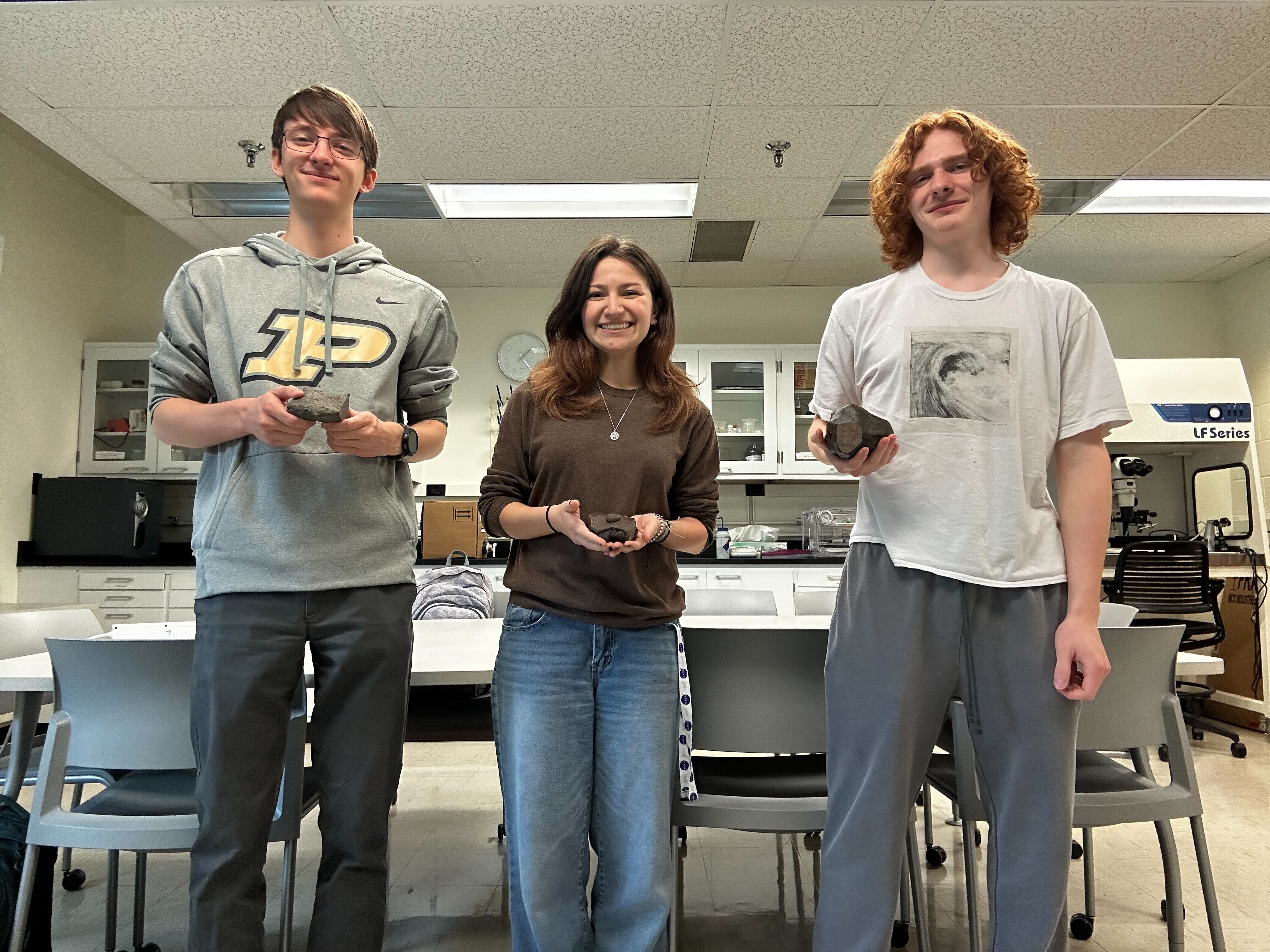
Trent Sample, Brianna Petruccelli, and Benjamin Kenworthy, in the primary lab used for analysis. (Photo provided by/Brianna Petruccelli)
Three Purdue University undergraduates spent the spring 2026 semester posing a deceptively simple question to space rocks: What are you?
The answer is written in minerals, textures, chemistry and tiny grains that formed more than 4 billion years ago. In the Department of Earth, Atmospheric, and Planetary Sciences (EAPS), undergraduate researchers Trent Sample, Benjamin Kenworthy and Brianna Petruccelli are studying meteorite samples from a collection on loan to EAPS from Purdue alumni and donors Paul and Florence Stahura. Florence Stahura, a 1992 Purdue graduate, also is among the crew members selected for Purdue 1, the university’s all-Boilermaker suborbital spaceflight with Virgin Galactic. The students are learning how planetary scientists classify meteorites and use them to better understand the earliest history of the solar system.
"This program is a wonderful opportunity for students to be involved in cutting-edge meteorite research, supported by Purdue alumni Paul and Florence Stahura," said Michelle Thompson, associate professor of EAPS.
The project gives students a rare chance to work with real meteorite samples while learning the same analytical methods used by researchers studying material from asteroids, the Moon, Mars and other planetary bodies.
"Meteorites are rocks that come from outer space and land on the Earth," Petruccelli said. "There are many different types of meteorites, and they're classified based on what they're made of and where they come from. As undergraduate research assistants in the Stahura Meteorite program, we are responsible for determining what type of meteorite each sample from the collection is."
The students analyzed thin slices of meteorite samples under a petrographic microscope, which uses light to reveal minerals, textures and structures that are difficult or impossible to see with the naked eye. They look for clues such as the minerals present, whether a sample contains chondrules, signs of shock or weathering, and how much of the rock is made of mineral grains compared with fine-grained background material.
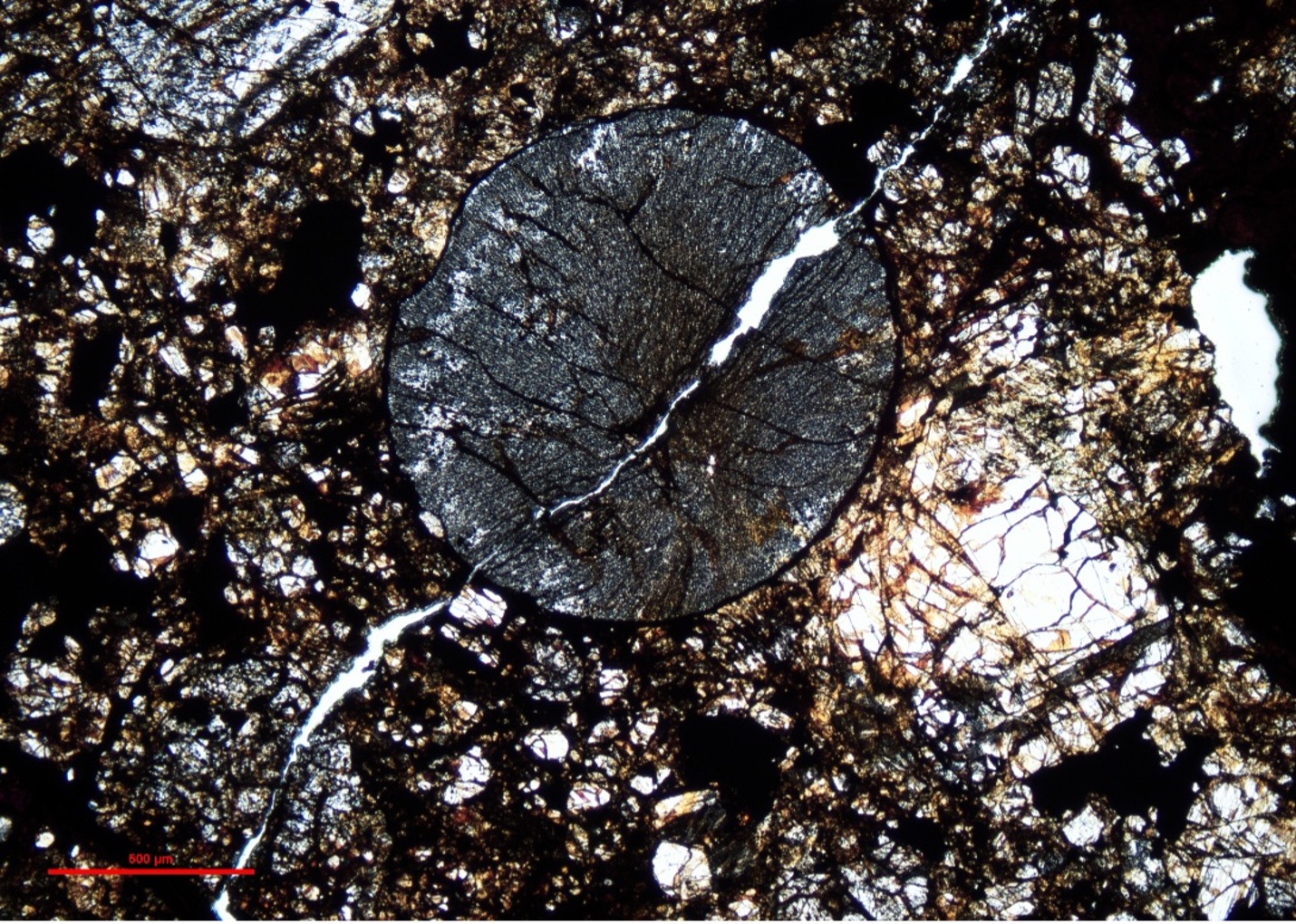
This is an image of meteorite sample STA016 in plain polarized light under a petrographic microscope. The circular object in the center is called a chondrule. (Photo provided by/Brianna Petruccelli)
Chondrules are small, rounded grains found in many primitive meteorites. They are among the earliest solid materials to have formed in the solar system, making them especially valuable to scientists trying to understand what the building blocks of planets looked like before planets fully formed.
The students also used a scanning electron microscope, or SEM, to gather chemical information from the samples. "Our research involves analyzing meteorites in order to determine what they are made of, how they have been changed since forming, and where they may have originated from," Sample said. "Altogether, we use this information to determine a classification for each individual meteorite."
When they were complete, students presented their classifications to EAPS faculty and researchers, receiving feedback and comparing their work against additional data, including oxygen-isotope information. Oxygen isotopes can act like a fingerprint, helping scientists connect a meteorite to a parent body or meteorite group.
"With support from the Stahuras, Purdue undergraduates Ben, Brianna and Trent are able to use advanced instrumentation to study previously unknown meteorites," said Marissa Tremblay, assistant professor of EAPS.
The research is highly collaborative. Thompson's lab has served as a central space for the work, and graduate student Lisette Melendez trained the undergraduate researchers on the petrographic microscope and SEM. Kelsey Prissel, assistant professor of EAPS, helped the students with petrographic techniques and thin section identification. Ryan Ickert, senior research scientist in EAPS, supported the data infrastructure needed to organize and store the students' notes and images. Tremblay helped organize the program, meetings, student onboarding and payroll. Cauê Borlina, the Gerald H. & Sharon D. Krockover New Frontiers Assistant Professor, and Tabb Prissel, assistant professor of EAPS, also provided insight during classification meetings.
"Trent, Ben and Brianna took full advantage of the technical resources in EAPS to probe these meteorites that are older than the Earth!" Ickert said.
The work also connects directly to what students learn in the classroom. The meteorite samples give them a chance to apply mineralogy, petrology and planetary science concepts to real extraterrestrial material.
"I have enjoyed watching the students apply what they learned and practiced in Mineralogy to this suite of meteorite samples we are fortunate to have on campus," Kelsey Prissel said.
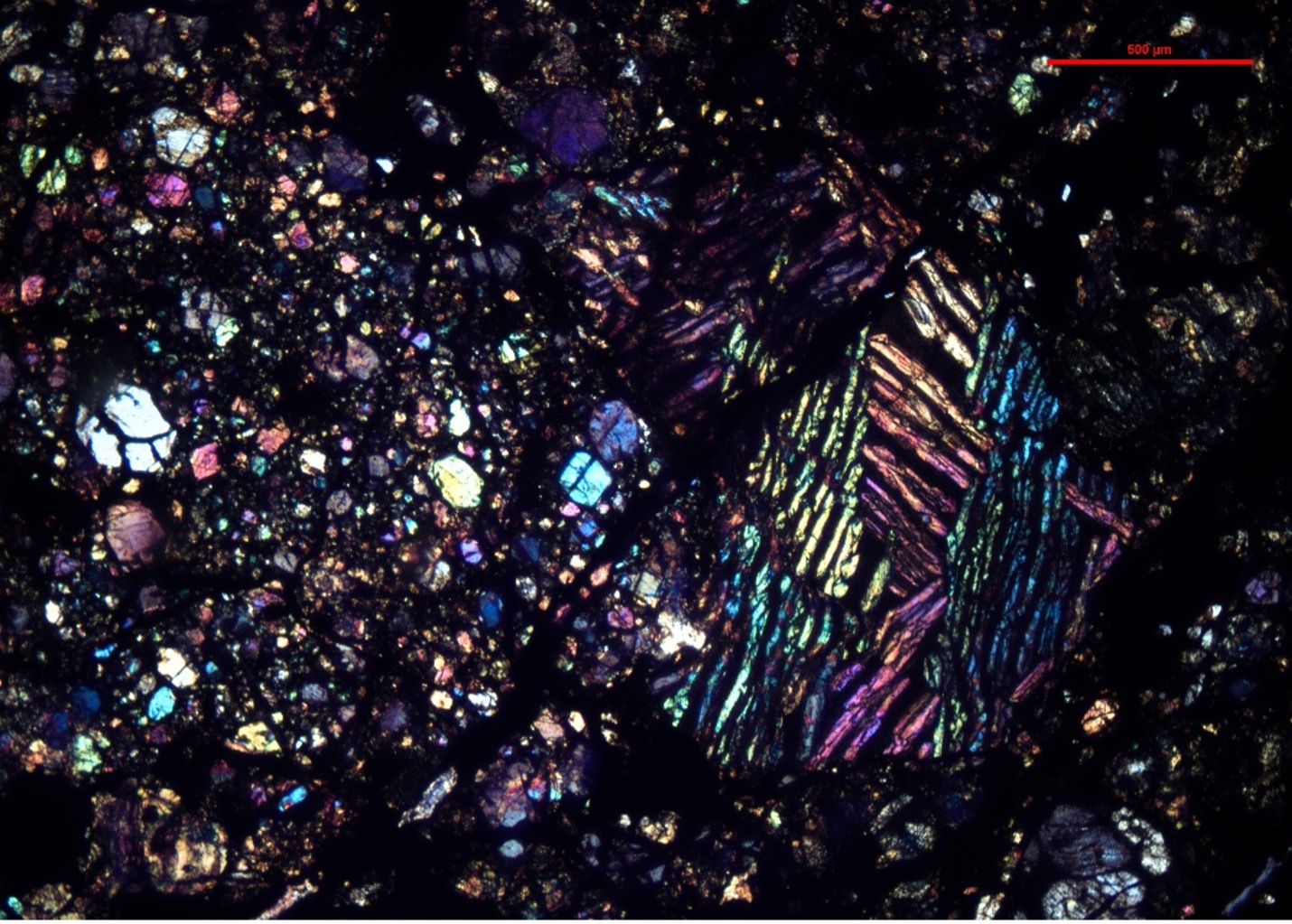
This image is of meteorite STA024 in crossed polarized light under a petrographic microscope. (Photo provided by/Brianna Petruccelli)
For Kenworthy, the work shows how scientists move from curiosity to confirmation. People often find unusual rocks and wonder if they could have come from the Moon, Mars or somewhere else beyond Earth. Meteorite research uses mineralogy, chemistry and isotopes to test those questions scientifically.
"Many enthusiastic people find a cool-looking rock and are quick to claim it as from the Moon or Mars, and our research shows how you can go from those ideas into actual confirmation and classification," says Kenworthy. "Not only identifying whether or not the rock is terrestrial, but also identifying the distinct location that the rock originates from. These are the exact processes conducted on Mars rovers to confirm suspicions about potential Martian rocks found here on Earth. Any further research of meteorites (such as ours) furthers humanity's ability to understand the extraterrestrial world around our own. One such new discovery being unraveled in our research was the rare presence of plagioclase in a Ureilite achondrite."
"The presence of plagioclase in ureilites is rare and scientifically significant because it points to a late-stage differentiation process on the ureilite parent asteroid," says Tabb Prissel. "Without observing and documenting its presence, that part of the story could easily remain untold in the meteorite record."
"By researching meteorites, we can advance our understanding of how our solar system evolved," Petruccelli said. "Meteorites act like little time capsules from the earliest stages of solar system formation, and can give us insight into the chemical and physical conditions that formed our Sun, asteroids, and the planets."
This type of undergraduate research is possible at Purdue because of the Stahura meteorite collection, support from Paul and Florence Stahura, and the technical resources available through EAPS, including petrographic microscopy and SEM analysis. The work also reflects the department's strength in planetary materials, meteorites and sample-based planetary science.
For the students, the project is a close-up view of planetary science in action. A meteorite thin section may fit on a microscope slide, but inside it are clues to worlds, impacts and conditions that existed long before humans, long before dinosaurs and even before Earth became the planet we know.
About the Department of Earth, Atmospheric, and Planetary Sciences at Purdue University
The Department of Earth, Atmospheric, and Planetary Sciences (EAPS) combines four of Purdue’s most interdisciplinary programs: geology and geophysics, environmental sciences, atmospheric sciences, and planetary sciences. EAPS conducts world-class research; educates undergraduate and graduate students; and provides our college, university, state and country with the information necessary to understand the world and universe around us. Our research is globally recognized; our students are highly valued by graduate schools and employers; and our alumni continue to make significant contributions in academia, industry, and federal and state government.
Written by: David Siple, communications specialist, Department of Earth, Atmospheric, and Planetary Sciences at Purdue University