Dinosaur-killing asteroid may have helped create a long-lived underground home for life
06-10-2026
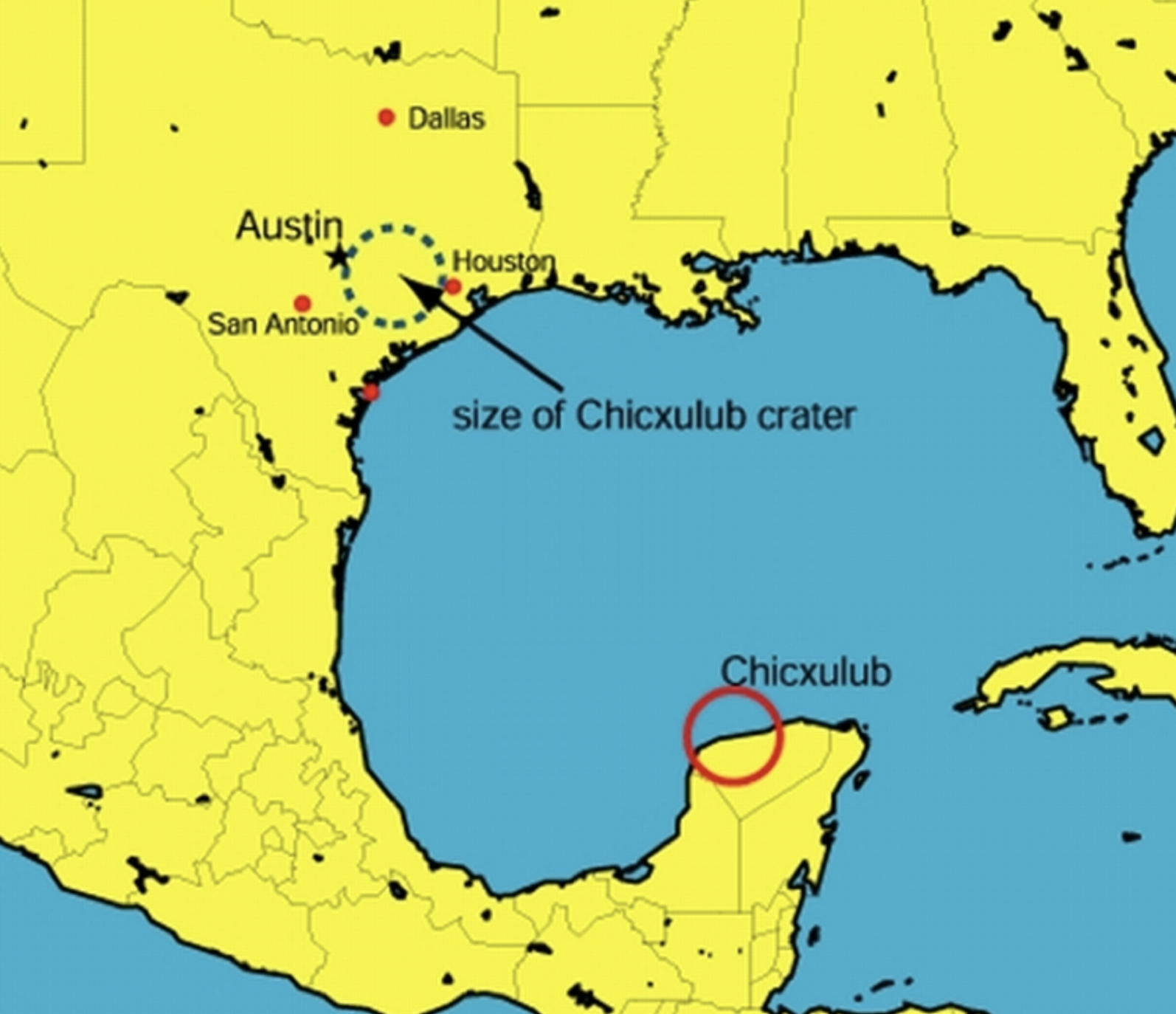
The Chicxulub Crater is mostly underwater just off the Yucatan Peninsula. It measures some 180 km across and nearly 20 km deep. From rim to rim, the diameter of this crater is roughly the distance from Austin to Houston, Texas. It is the third largest confirmed impact structure on Earth. (Image courtesy/NASA)
The asteroid that ended the age of dinosaurs also created something unexpected deep beneath the surface. A warm, water-rich environment that may have lasted for millions of years and could offer clues about where life might arise on Earth and other planets.
A new international study published in Communications Earth & Environment found that the hydrothermal system beneath the Chicxulub impact crater in Mexico persisted for several million years after the impact, far longer than previously thought.
"The Chicxulub impact crater in Mexico was created 66.04 million years ago when an asteroid struck the Earth, and has long been linked to the mass extinction that occurred at the end of the Cretaceous Period in Earth history when dinosaurs went extinct," said Marissa Tremblay, assistant professor of earth, atmospheric, and planetary sciences at Purdue University. "When the impact occurred, a hydrothermal system formed in the crater, meaning that there were warm fluids moving around in the fractured rock. The main finding of this paper is that the hydrothermal system at Chicxulub persisted for several million years after the impact, much longer than people had previously thought."
The study was led by researchers at SUERC, or the Scottish Universities Environmental Research Centre, and the University of Glasgow. Researchers analyzed samples collected during a 2016 drilling expedition into the crater's peak ring. The samples contained potassium-rich feldspar minerals that formed from hot fluids moving through the crater after the impact.
Those minerals were dated using argon-argon geochronology and produced ages much younger than the impact itself, some as young as 58 million years old. That raised an important question whether the younger ages were caused by a later heating event, or whether they recorded minerals forming long after the asteroid hit. That is where Tremblay's work came in.
The geochronology measurements revealed ages that were younger than expected for rocks from the Chicxulub impact crater. Tremblay performed laboratory experiments and mathematical modeling to test whether the dating system could have been disturbed by an unrelated heating event after the impact. Her results showed that explanation was unlikely, supporting the idea that some minerals formed later from hydrothermal fluids moving through the crater.
"I primarily use measurements of noble gases (helium, neon, argon) in rocks to understand their geologic history," Tremblay said. "I do some computational work to predict how noble gases will behave in different materials over geologic timescales and under different geologic conditions, which is how I contributed to this paper."
The findings suggest the Chicxulub hydrothermal system may have remained active for about 8 million years, making it the longest-lived impact-generated hydrothermal system yet documented. That matters because warm water moving through fractured rock can create protected spaces where microbial life may survive or develop.
"One implication of this work is that, if hydrothermal systems in impact craters can last for a long time like the one at Chicxulub, then they might be good places for life to develop, either on the early Earth or on other planets," Tremblay said.
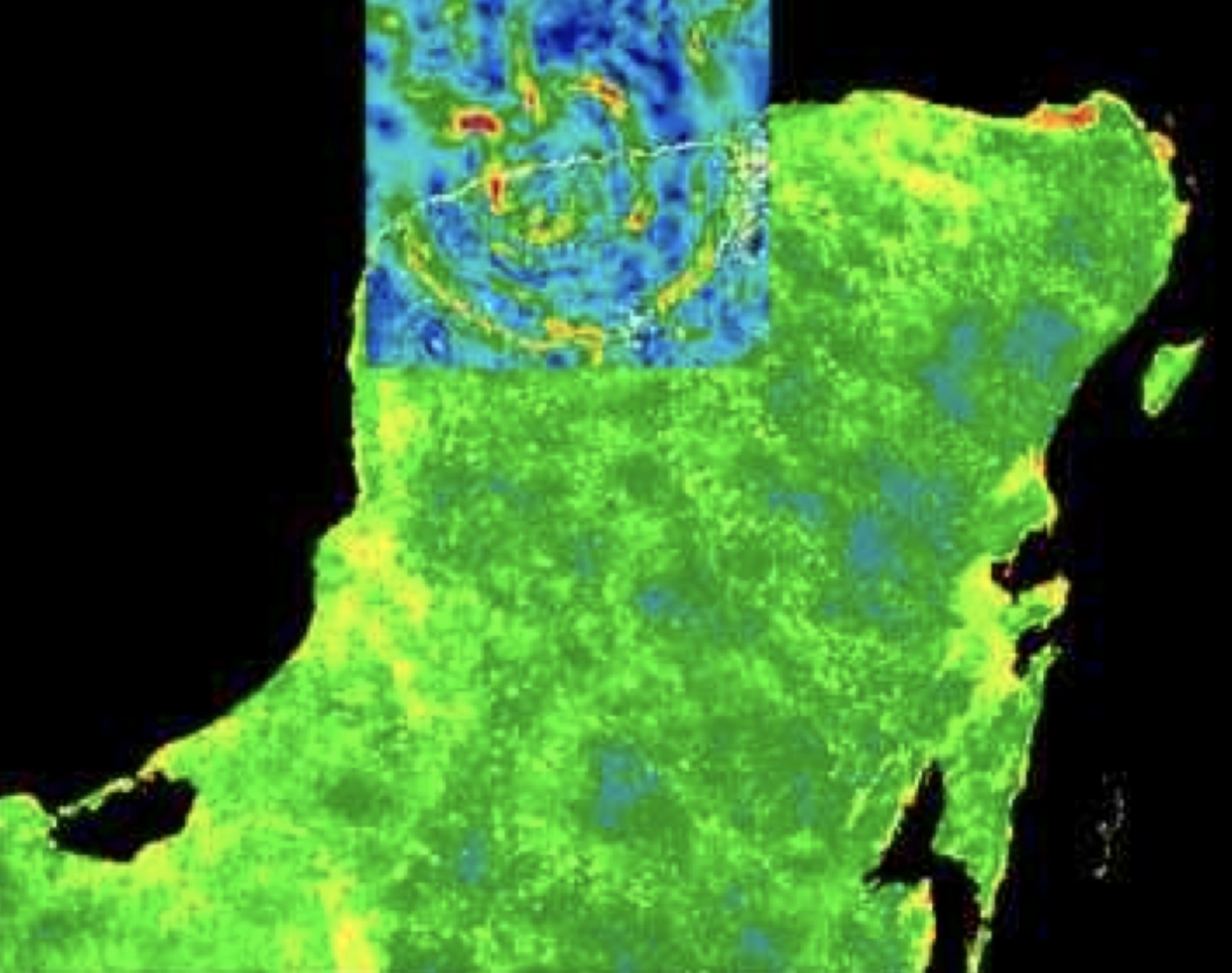
A gravity anomaly map of the Chicxulub Crater area superimposed on the Yucatan Peninsula shows areas of mass concentrations (i.e., the yellow and red areas are ‘gravity highs’ whereas the green and blue areas are ‘gravity lows’). The aftermath of the impact led to the extinction of about 75% of all species on Earth. (Image courtesy/NASA)
The work also has implications for the search for life beyond Earth. Planets such as Mars experienced many large impacts early in their histories, including during periods when water may have been more abundant. If those impacts created long-lived hydrothermal systems, ancient impact craters could be promising places to look for signs of past habitability.
The paper, "A long-lived impact-generated hydrothermal system at the Chicxulub impact structure," was published in Communications Earth & Environment. Researchers from the University of Glasgow, Purdue University, the University of Texas at Austin, the Universities Space Research Association, HNU Neu-Ulm University of Applied Sciences, Imperial College London, the University of Western Ontario, the University of Arizona, Stanford University, Arizona State University and the University of St Andrews contributed to the study.
The research was supported by funding from the European Consortium for Ocean Research Drilling, the International Continental Scientific Drilling Program, the Yucatan State Government and Universidad Nacional Autónoma de México, the Natural Science and Engineering Research Council of Canada, the University of Glasgow, the Leverhulme Trust, and UKRI's Natural Environment Research Council.
The research has been covered by the BBC, Phys.org, and MSN.
About the Department of Earth, Atmospheric, and Planetary Sciences at Purdue University
The Department of Earth, Atmospheric, and Planetary Sciences (EAPS) combines four of Purdue’s most interdisciplinary programs: geology and geophysics, environmental sciences, atmospheric sciences, and planetary sciences. EAPS conducts world-class research; educates undergraduate and graduate students; and provides our college, university, state and country with the information necessary to understand the world and universe around us. Our research is globally recognized; our students are highly valued by graduate schools and employers; and our alumni continue to make significant contributions in academia, industry, and federal and state government.
Written by: David Siple, communications specialist, Department of Earth, Atmospheric, and Planetary Sciences at Purdue University