Discovery from NASA's Perseverance rover adds new evidence that early Mars had the chemistry needed for life
04-22-2026
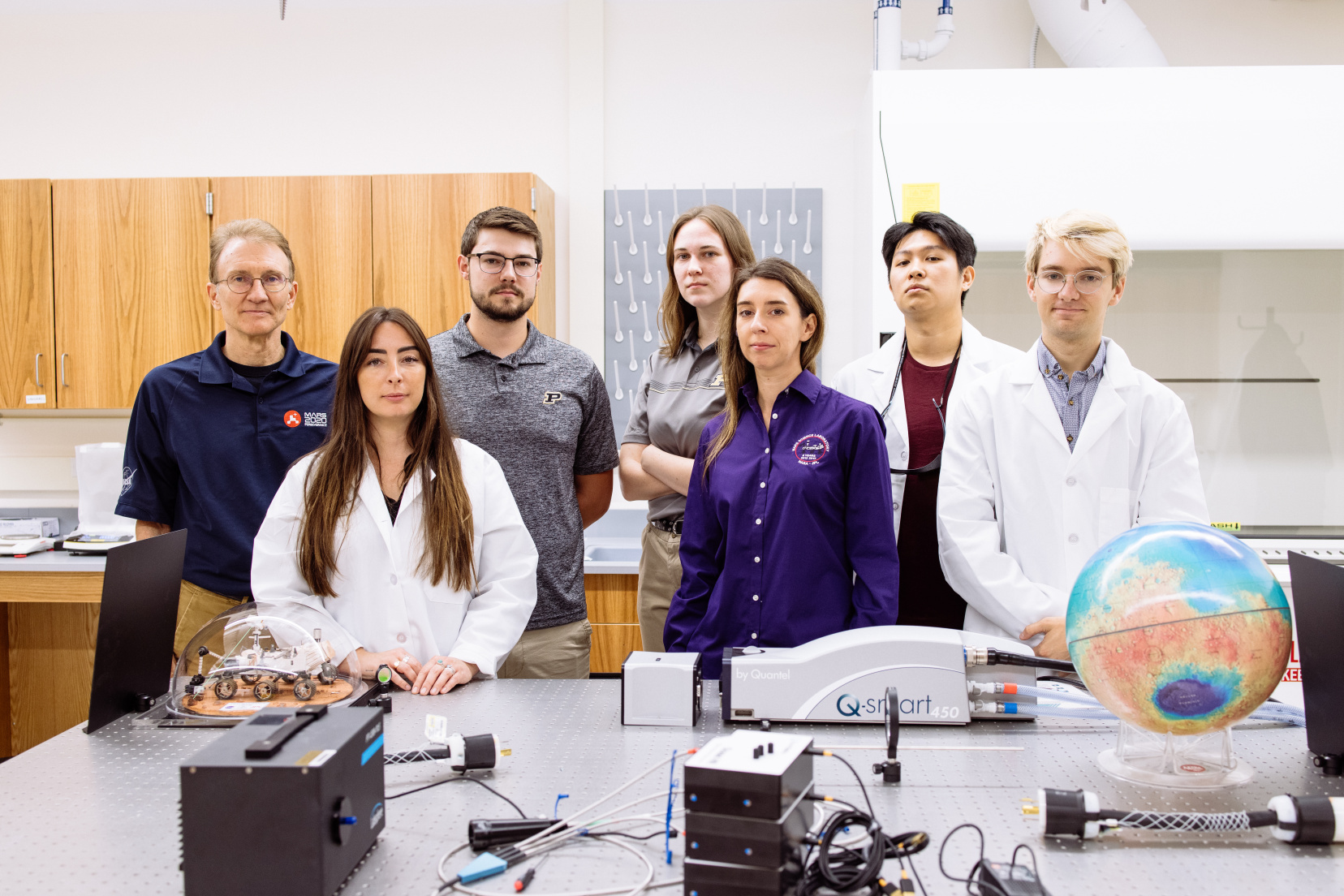
From left to right: Roger Wiens, Stephanie Connell, Noah Martin, Mia Rudin, Candice Bedford, DJ Lee, and Henry Manelski. (Photo credit/Purdue University)
A Purdue University-led study of rocks on Mars is giving scientists a new look at whether the red planet once had the right chemical conditions for life.
Using data collected by NASA's Perseverance rover, researchers found unusually high concentrations of nickel in Neretva Vallis, an ancient river valley that once carried water into Jezero Crater. The nickel-rich rocks were found alongside reduced sulfur and organic carbon, an intriguing combination for scientists studying the chemistry that may have supported life long ago.
The discovery was led by Henry Manelski, a former doctoral candidate in Purdue's Department of Earth, Atmospheric, and Planetary Sciences (EAPS), and published March 31 in Nature Communications. Purdue co-authors include Roger Wiens, professor in EAPS; Adrian Broz, postdoctoral researcher; Stephanie Connell, postdoctoral researcher at Los Alamos National Lab; and Candice Bedford, research scientist. Manelski led the study and built the calibration used to quantify nickel in the Martian rocks, while the Purdue team helped interpret the data and refine the manuscript. (Additional authors listed at the end of this release)
The study reports nickel detections in 32 rock targets in Neretva Vallis, with concentrations reaching about 1.1 weight percent in individual rocks, the highest abundance yet seen in bedrock on Mars. The rover's SuperCam instrument first identified the nickel, and the PIXL instrument helped show where the element was concentrated at a finer scale. Together, the instruments revealed nickel associated with iron sulfides and their weathering products, helping researchers connect the chemistry to the ancient environment in which the rocks formed.
"Nickel is actually quite rare on Earth's surface because most of it sank into the planet's core when Earth was forming," Manelski said. "But nickel is important - it helps speed up chemical reactions that were likely crucial for the earliest forms of microbial life on our planet."
That is part of what makes the Mars discovery so compelling. Neretva Vallis is already of high interest because Perseverance previously found organic carbon and reduced sulfur there, chemical clues that point to a complex and potentially habitable ancient setting.
The new nickel detections add another piece to that puzzle, especially because nickel is an essential element in some of Earth's oldest microbial metabolisms. The paper notes that the chemistry and appearance of the Martian iron sulfides resemble pyrite found in some very old sedimentary rocks on Earth.
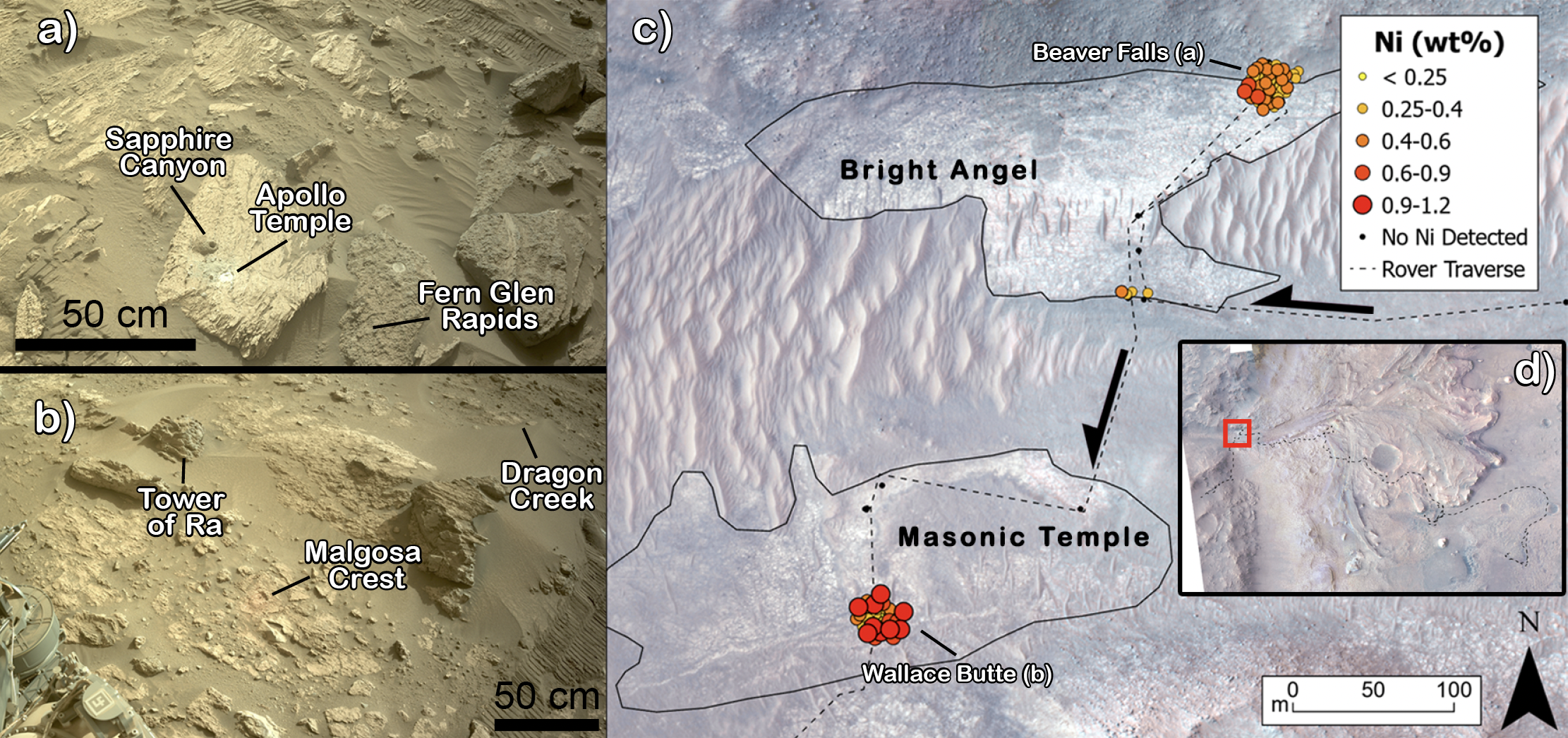
Perseverance rover Navcam images of the Beaver Falls (a) and Wallace Butte (b) workspaces. The sample borehole (Sapphire Canyon), PIXL scans (Apollo Temple and Malgosa Crest), and rocks with major Ni-enrichments detected by SuperCam (Apollo Temple, Fern Glen Rapids, Dragon Creek, and Tower of Ra) are labelled. c Nickel detections with SuperCam in Neretva Vallis, showing the locations of the Bright Angel and Masonic Temple outcrops (points offset for clarity). Half arrows indicate the direction of travel of Perseverance. d Context HiRISE composite image of Jezero crater with red box to indicate the extent of panel (c). Image Credit: NASA/JPL-Caltech.
"What's especially interesting is that these nickel-rich areas also contain organic carbon and patches of reduced sulfur, which has been previously described a 'potential biosignature'," Manelski said. "Together, these findings support the hypothesis that the right chemical conditions, and even some of the building blocks for life, likely existed on Mars billions of years ago."
At Purdue, the work centered on analyzing laser-induced breakdown spectroscopy, or LIBS, data from SuperCam, one of Perseverance's key science instruments. In the Wiens Lab, researchers also created nickel-rich standards that were essential for calibrating the instrument's measurements before those standards were analyzed further at Los Alamos National Laboratory. That combination of instrument expertise, geochemical interpretation and collaboration helped make the study possible.
Manelski described the team's approach as a way of reading chemical clues preserved in Martian rocks, almost like uncovering a record of an ancient environment that no longer exists. In this case, the record points to a place where water, chemically reactive elements and organic material once came together in ways that scientists are still working to understand.
The work also helps scientists interpret a rock sample collected by Perseverance at the site, called "Sapphire Canyon," which is being considered for eventual return to Earth through a future Mars Sample Return effort. If that sample is brought back, researchers will be able to test it with far more powerful laboratory tools than can fit on a rover, potentially answering bigger questions about where the nickel came from and what it reveals about early Mars.
"Our discovery will be used to inform theoretical and experimental science which aims to better understand the environmental conditions on ancient Mars and determine if conditions were right for life," Manelski said. "This work is also important for helping to contextualize the Martian sample collected here called 'Sapphire Canyon.' If this sample is one day returned to Earth, this work will be critical for interpretation."
The study included collaborators from Stony Brook University, Texas A&M University, Los Alamos National Laboratory, Université Claude Bernard Lyon 1, the University of Alberta, IRAP, Washington University in St. Louis, the DLR Institute of Space Research, the Institut de Planétologie et d'Astrophysique de Grenoble, the U.S. Geological Survey, the University of Winnipeg and NASA's Jet Propulsion Laboratory. Joel Hurowitz, professor at Stony Brook University, played a particularly significant role in helping refine the team's interpretation of the nickel discovery, according to Manelski.
This work was supported in the United States by the NASA Mars Exploration Program under grant number NNH13ZDA018O.
About the Department of Earth, Atmospheric, and Planetary Sciences at Purdue University
The Department of Earth, Atmospheric, and Planetary Sciences (EAPS) combines four of Purdue’s most interdisciplinary programs: geology and geophysics, environmental sciences, atmospheric sciences, and planetary sciences. EAPS conducts world-class research; educates undergraduate and graduate students; and provides our college, university, state and country with the information necessary to understand the world and universe around us. Our research is globally recognized; our students are highly valued by graduate schools and employers; and our alumni continue to make significant contributions in academia, industry, and federal and state government.
Written by: David Siple, communications specialist, Department of Earth, Atmospheric, and Planetary Sciences at Purdue University