Purdue geologist Michael Eddy receives national early career award for Earth history research
03-30-2026
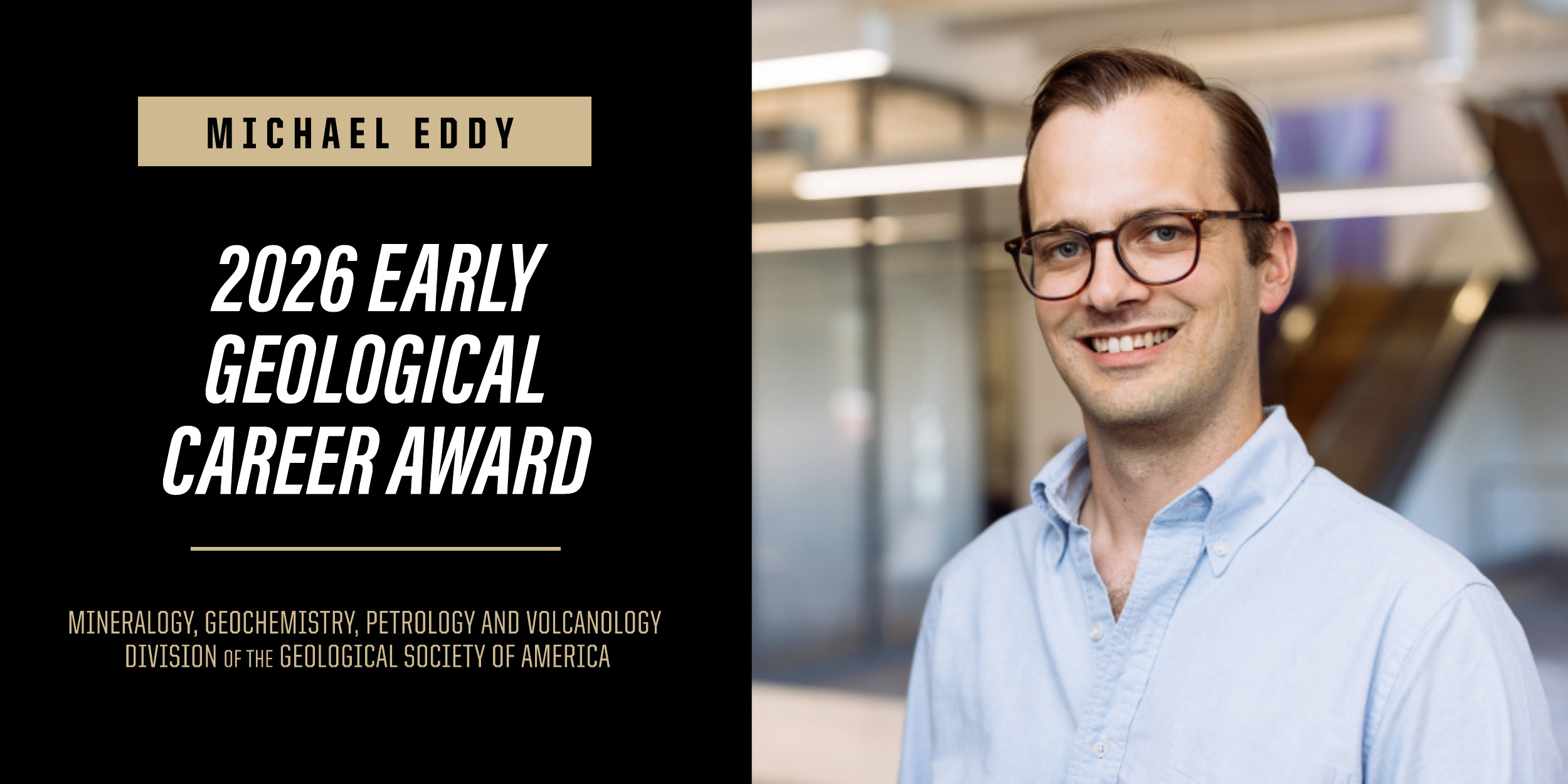
Michael P. Eddy, an associate professor in Purdue University's Department of Earth, Atmospheric, and Planetary Sciences, has received the 2026 Early Geological Career Award from the Geological Society of America's Mineralogy, Geochemistry, Petrology and Volcanology Division. The award recognizes scientists near the beginning of their careers who have made distinguished, multidisciplinary and field-based contributions to geology.
Eddy was recognized for what the division described as exceptional research productivity and impact, a collaborative and collegial approach to science, dedication to student mentorship, and a research program deeply rooted in fieldwork.
"My research is focused on creating detailed timelines of events and processes in Earth's history using radiometric dating techniques," Eddy said. "We use this approach to study the guts of ancient volcanoes, to assess how tectonic plates interact, and to calibrate how quickly the Earth's biosphere and climate have changed in the past."
That work has helped make Eddy widely known in zircon geochronology, where he has contributed both major scientific insights and practical community resources, including reference materials and support for new laboratories. His pioneering work is helping researchers better understand magma generation and emplacement, volcanic eruption mechanisms, exhumation, and links among magmatism, basin development, strike-slip faulting and climate change.
Eddy said geologists are now in the midst of a major shift in how they connect events across Earth history. "I think that there are quite a few outstanding questions about geology that can only be answered through the temporal correlation of rocks," he said. "I think that we are in the middle of a third revolution in which analytical advances are allowing us to make isotopic measurements with increasing precision. This precision now allows us to correlate geological records at incredibly fine timescales."
Those advances are opening new lines of inquiry about the pace and causes of major geologic and biologic change. "So we can now ask questions like: 'Can we link an individual volcanic eruption with processes preserved within exhumed intrusive igneous rocks?' or 'Do mass extinctions occur over centuries, millennia, millions of years?'" Eddy said.
His research program at Purdue depends on both field geology and high-precision laboratory analysis. Eddy said one key to making this work possible is Purdue's investment in specialized facilities. "A critical component of my research is the ability to make high precision isotopic measurements of U and Pb," he said. "These measurements allow us to determine the age of geological materials with uncertainties <0.1%." Because lead is so common in the environment, he added, Purdue built a clean lab for his group to analyze geologic materials. "This represents a major investment on the part of the University and the laboratory is just one of a handful around the globe that can make similar measurements."
Eddy said the value of geology is that it provides scientists a method to test ideas that can't be recreated in a lab. "Most Earth processes occur on timescales that are difficult, or impossible, to reproduce in the laboratory," he said. "Computational modeling can help bridge this gap. However, these results must be benchmarked and checked against natural examples. My group focuses on using geological techniques to reconstruct temporal records of various volcanic, tectonic, and climatic processes using ancient examples."
His recognition is especially meaningful, coming from peers in the field. "I'm delighted to be recognized by the Geological Society of America," Eddy said.
Ken Ridgway led Eddy's nomination. Others connected to Eddy's research group include former postdoctoral researcher Maddie Lewis, now an assistant professor at the University of Wyoming; former doctoral student Erin Donaghy, now an assistant professor at the University of Nevada, Las Vegas; former doctoral student Disha Okhai, now an instructor at the University of Oregon; and Purdue researchers Sourav Karmakar, Brandon Keough and Rachel Miller.
Eddy will be formally recognized at a special awards session during the 2026 Geological Society of America Connects meeting, scheduled for Oct. 11-14 in Denver, Colorado. The award includes a $1,000 cash prize and up to $1,500 in travel reimbursement.
About the Department of Earth, Atmospheric, and Planetary Sciences at Purdue University
The Department of Earth, Atmospheric, and Planetary Sciences (EAPS) combines four of Purdue’s most interdisciplinary programs: geology and geophysics, environmental sciences, atmospheric sciences, and planetary sciences. EAPS conducts world-class research; educates undergraduate and graduate students; and provides our college, university, state and country with the information necessary to understand the world and universe around us. Our research is globally recognized; our students are highly valued by graduate schools and employers; and our alumni continue to make significant contributions in academia, industry, and federal and state government.
Written by: David Siple, communications specialist, Department of Earth, Atmospheric, and Planetary Sciences at Purdue University
Contributor: Michael P. Eddy, associate professor, Department of Earth, Atmospheric, and Planetary Sciences at Purdue University
Photo by: Brian Powell