Oldest magnetic evidence sheds light on how the solar system formed
08-24-2026
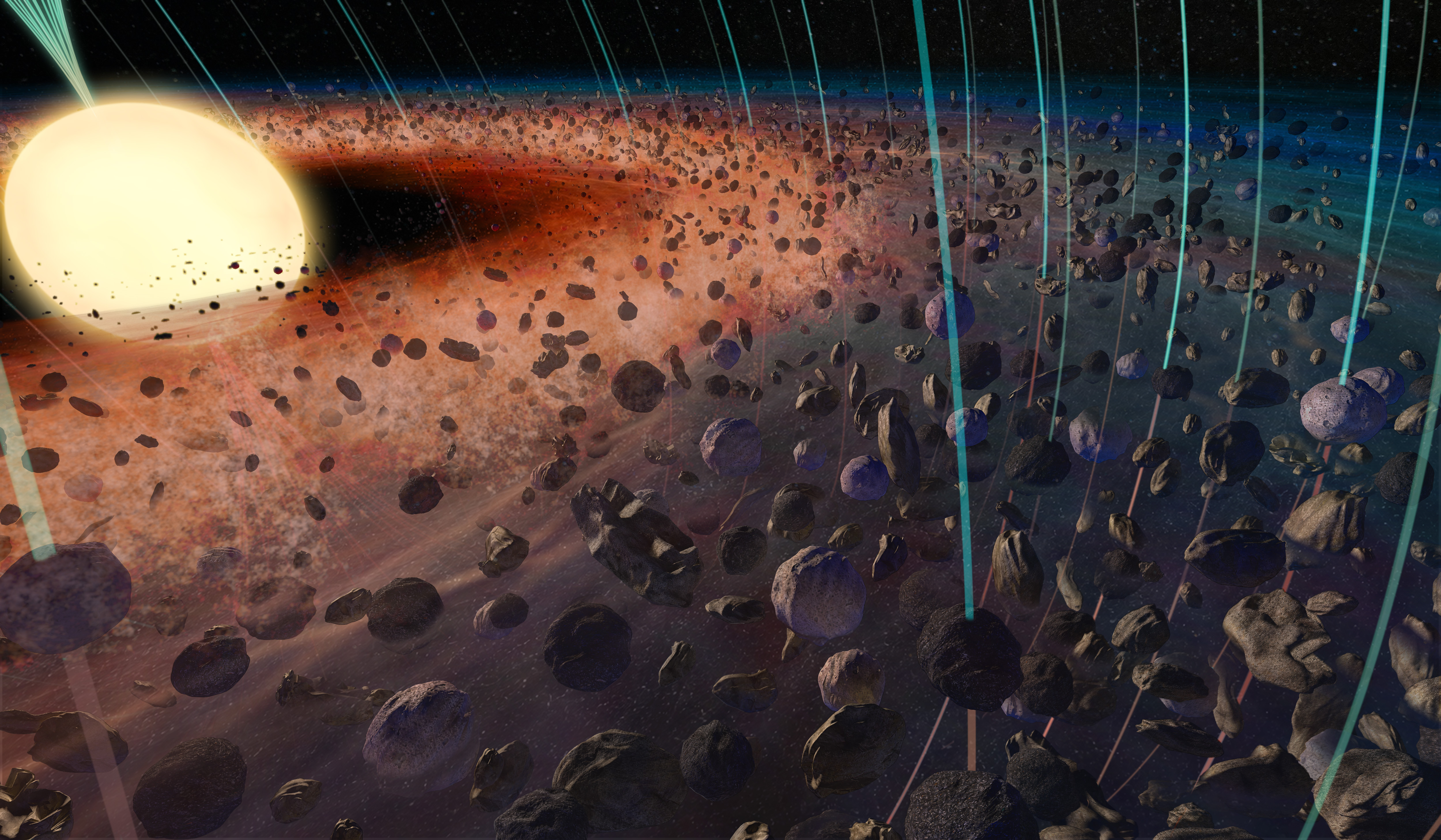
Artist’s rendering of the early solar system, where magnetic fields threaded through the disk of gas and dust surrounding the young sun. New paleomagnetic evidence preserved in some of the solar system’s oldest materials is helping researchers reconstruct the magnetic environment in which the planets began to form. (Illustration by/Hernán Cañellas)
Over 4.5 billion years ago, before Earth formed and the planets took shape, the solar system was a massive cloud of gas and dust collapsing around the young Sun. While gravity has usually been seen as the main force behind this process, microscopic grains found inside an Antarctic meteorite indicate that other forces may have also played a role.
Researchers have found the oldest known paleomagnetic evidence of a magnetic field in the solar system, preserved in material that formed within roughly the first 20,000 to 200,000 years of its history. Their measurements indicate the magnetic field was about three to 12 times stronger than Earth's magnetic field today and support the idea that magnetism played an important role in moving material through the disk from which the Sun and planets eventually formed.
The research is led by Cauê Borlina, the Gerald H. & Sharon D. Krockover New Frontiers Assistant Professor in Purdue University's Department of Earth, Atmospheric, and Planetary Sciences. Borlina is the lead author of "Paleomagnetic Evidence for a Nebular Magnetic Field from Calcium-Aluminum-rich Inclusions," which was recently published in the Proceedings of the National Academy of Sciences.
"Nowadays people don't debate whether magnetism is present when planets are forming. But the debate is around the very early solar system, before planets are forming, when there's just a disk," Borlina said. "That's where the debate still resides, and that's where we're operating now."
To reach that far back in time, the researchers turned to calcium-aluminum-rich inclusions, or CAIs. These mineral-rich grains were among the first solids to form in the solar system and can survive inside primitive meteorites for billions of years.
The CAIs used in the study came from DOM 08006, a meteorite discovered in 2008 in the Dominion Range along the East Antarctic ice sheet. The meteorite is especially valuable because it has undergone little alteration during its journey through the solar system’s history. Meteorites can be changed by water, heat, collisions and processes on their parent bodies. All of which can potentially disturb the ancient signals scientists are trying to recover. DOM 08006 retained much of its original mineral composition.
"We know they are the oldest things we have of the early solar system," Borlina said. "But CAI's are very complex and are not all the same, even within a 1-millimeter piece of the meteorite. So we have to carefully identify what types they are."
From pieces of the meteorite, the researchers isolated tiny CAIs containing inherently magnetic minerals, including iron. They then carried out a series of experiments to determine when the grains formed and whether they still carried a magnetic signal from that ancient environment.
The grains retained evidence of a magnetic field from a period when the solar system was still undergoing one of the most consequential changes in its history: the transition from a collapsing cloud into a flattened protoplanetary disk.
"This transition, from a spherical cloud to a protoplanetary disk, is probably one of the most significant events in all of solar system history," said Benjamin Weiss, the Robert R. Shrock Professor of Earth and Planetary Sciences at MIT. "It has long been theorized that gravity caused this, but our measurements show magnetism likely played a role, possibly even a dominant one."
The team estimated that the field recorded by the CAIs was about 150 to 600 microteslas, compared with roughly 50 microteslas for Earth's magnetic field today. The measurement gives researchers physical evidence against which they can test models of how gas and other material behaved during the solar system's earliest stages.
"We think these kinds of magnetic fields were helping to move gas from the protoplanetary disk, in toward this central star, the Sun," Borlina said. "Gravity is also playing a role. But we are now showing that, if you want to fully understand how the Sun and planets formed, you should include magnetic fields in the ingredients that make them."
How gas moved through the disk affected more than the Sun's growth. The movement and distribution of material helped establish the chemical reservoirs from which planets would later form, shaping the solar system's eventual architecture.
The findings also give planetary scientists a rare way to investigate a process that is difficult to observe elsewhere in the universe. Astronomers can see disks of gas and dust surrounding young stars but directly measuring magnetic fields within the regions where planets form is challenging. The magnetic record preserved in ancient solar system materials provides another way to understand the forces that may be operating in planetary systems beyond our own.
The research began during Borlina's doctoral work in Weiss' laboratory at MIT. Scientists there used a superconducting quantum interference device, or SQUID, microscope, an instrument sensitive enough to measure magnetic fields preserved within extremely small samples such as the CAIs studied in the paper. That capability is now coming to Purdue.
Borlina leads the Purdue Magnetics Laboratory, or PMag Lab, where his group uses paleomagnetism to extract magnetic records from tiny mineral grains and combines those measurements with modeling. The group's research ranges from meteorites and returned extraterrestrial samples to Earth's magnetic history, the formation of giant planets and the magnetic environments of icy moons. Some of the grains researchers work with are only about 100 microns across.
With assistance from MIT, the group is building a SQUID microscope at Purdue, giving researchers here the ability to make similarly sensitive measurements of small samples. Borlina also holds a courtesy appointment in Purdue's Department of Physics and Astronomy.
For Borlina, those next steps are part of a broader effort to understand what magnetism can reveal about the history of planets and the environments they inhabit. "My group is interested in understanding how magnetic fields, past and present, shape the formation and evolution of planets, and how it might influence past and present habitability," Borlina said.
About the Department of Earth, Atmospheric, and Planetary Sciences at Purdue University
The Department of Earth, Atmospheric, and Planetary Sciences (EAPS) combines four of Purdue’s most interdisciplinary programs: geology and geophysics, environmental sciences, atmospheric sciences, and planetary sciences. EAPS conducts world-class research; educates undergraduate and graduate students; and provides our college, university, state and country with the information necessary to understand the world and universe around us. Our research is globally recognized; our students are highly valued by graduate schools and employers; and our alumni continue to make significant contributions in academia, industry, and federal and state government.
Written by: David Siple, communications specialist, Department of Earth, Atmospheric, and Planetary Sciences at Purdue University