Ancient seams may guide how tectonic plates tear beneath Alaska
08-13-2026
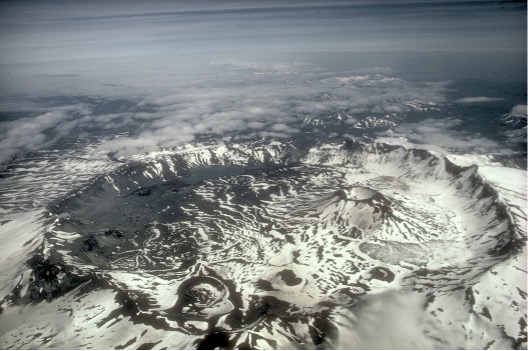
An aerial view shows Aniakchak caldera on the Alaska Peninsula. Purdue researchers found evidence that a subducting tectonic plate is tearing beneath the region along an inherited weak zone called an oceanic plate joint. (Photo Credit: M. Woodbridge Williams, National Park Service)
Purdue researchers used Earth's background vibrations to create a three-dimensional image of a sinking tectonic plate, revealing how weaknesses formed millions of years ago may influence volcanoes, earthquakes and mantle flow.
Deep beneath the Alaska Peninsula, a sinking tectonic plate appears to be tearing along an ancient weak spot created millions of years before the plate reached the region. The discovery may help scientists better understand why tectonic plates tear as they descend into Earth and how those openings affect earthquakes, volcanic activity and the movement of hot material through the mantle.
The research was led by Vincent Sassard, a Ph.D. candidate in Purdue University's Department of Earth, Atmospheric, and Planetary Sciences, and Xiaotao Yang, an assistant professor in the department. Their paper, "Slab tearing along a subducted oceanic plate joint beneath the Alaska Peninsula," was published in Nature Geoscience.
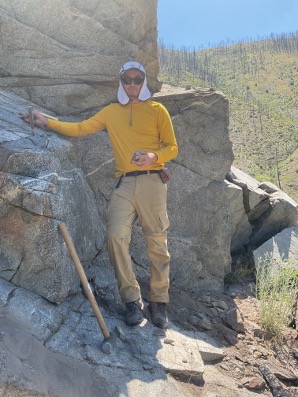
Vincent Sassard, a Ph.D. candidate in Purdue University’s Department of Earth, Atmospheric, and Planetary Sciences, conducts fieldwork in the Northern Cascades during summer 2023. (Photo Credit: Sourav Karmakar.)
Yang initiated and coordinated the study and supervised Sassard, who processed the seismic data and carried out the seismic imaging. Together, they analyzed and interpreted the results, integrated them with independent observations and wrote the manuscript.
Tectonic plates are large, rigid sections of Earth's outer shell that slowly move over the asthenosphere, a hotter and more flexible layer of the mantle. At subduction zones, one tectonic plate bends and sinks beneath another, recycling old seafloor into Earth's interior. Although tectonic plates can appear solid and continuous at the surface, they carry structures inherited from the way they originally formed.
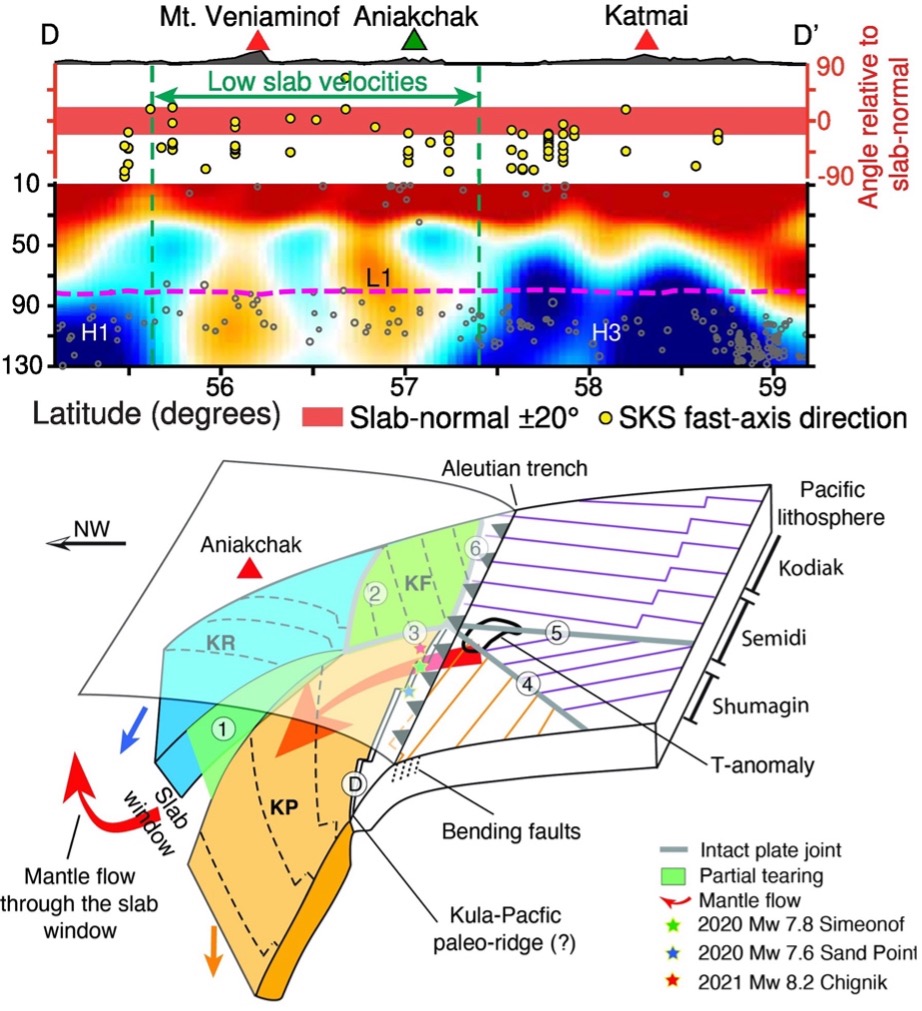
Figure 1: Cross-section along the 80-km slab contour of our shear wave velocity model along with our summary cartoon. (Top) L1 indicates low seismic velocities (4.2 km/s) underneath Aniakchak, and H1 and H3 indicate high seismic velocities (4.8 km/s). (Bottom) The solid and dashed lines represent the oceanic plate fabrics inferred from magnetic anomalies and from plate reconstruction models, respectively. The circled numbers and letters indicate oceanic plate joints and extinct spreading ridges, respectively. KF -- Kula-Farallon, KP -- Kula-Pacific, KR -- Kula-Resurrection. (Figure provided by: Vince Sassard)
New oceanic lithosphere is created at mid-ocean ridges, where plates move apart and molten material rises to form a new seafloor. This process leaves linear structures, known as plate fabrics, within the newly formed lithosphere. When spreading ridges branch, intersect or change direction, fabrics with different orientations can intersect one another. The Purdue researchers refer to those zones as "oceanic plate joints."
Millions of years after they form, these joints may reach a subduction zone as part of an oceanic plate. As the plate bends and descends, these old structures can be reactivated as weak zones. The team's findings suggest that stress can become concentrated along these inherited weak zones, allowing the plate to tear apart along these joints.
"You could think of a sheet of paper that you want to tear without scissors. You fold it, flatten it back, and fold it again in the other direction. Now, your sheet of paper is scarred and weakened in that place which allows you to tear your paper in a precise location that you would not have been able to follow if you didn't have that pre-conditioned weakened feature," Sassard said.
The researchers used seismic imaging based on the constant background vibrations moving through Earth to look beneath the area of interest. "Similarly to X-ray in medical imaging, we listen to the background noise of the Earth to create a 3-D high-definition image of what's underground in the Alaska Peninsula," Sassard said.
The resulting high-resolution model revealed changes in seismic velocity along the subducting plate. Those differences can give researchers information about the temperature, composition and physical condition of material beneath the surface.
Near Aniakchak volcano, the researchers identified an area where seismic waves traveled more slowly. That region aligned with the reconstructed location of an oceanic plate joint and with a gap in deeper earthquakes beneath the Alaska Peninsula.
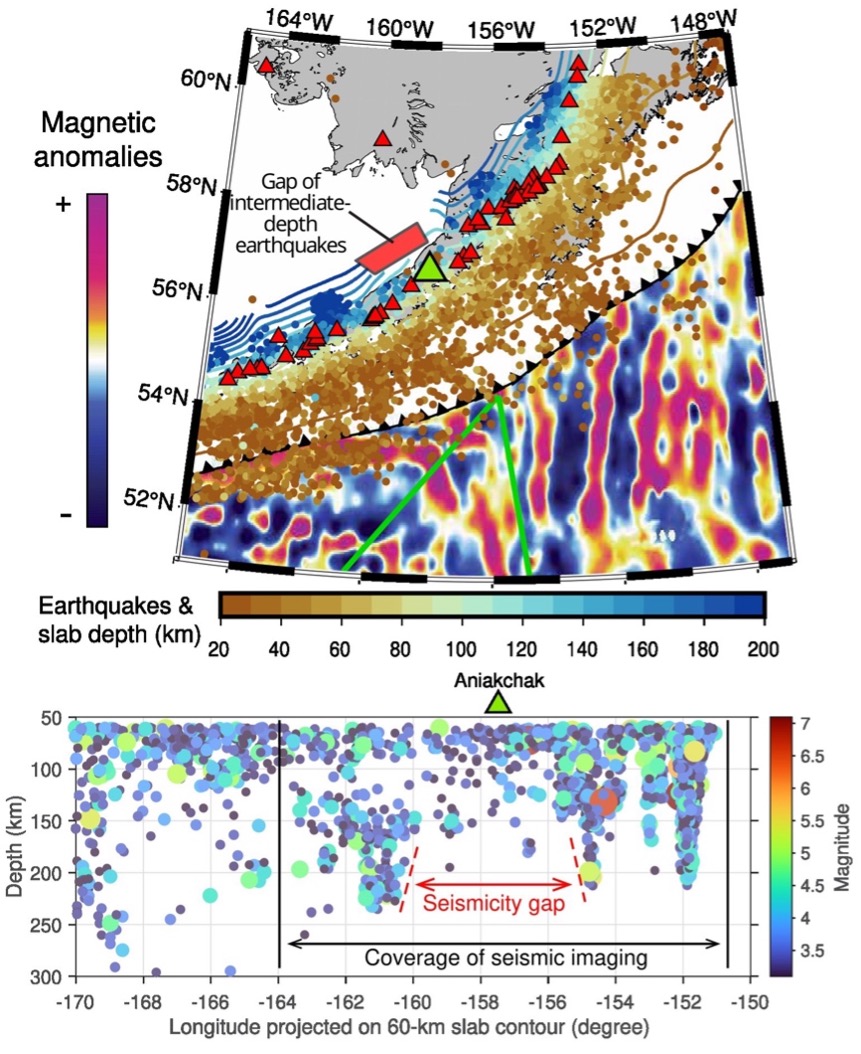
Figure 2: Earthquakes, slab contours, and magnetic anomalies around the Alaska Peninsula. (Top) Aniakchak volcano is highlighted by a green triangle and the red triangles are the other Aleutian volcanoes. The green lines show oceanic plate joints while the colored curves north of the trench (black toothed curve) indicate slab depth contours. The dots correspond to earthquakes of magnitude higher than 3, color-coded by depth. South of the trench, the background colors show the magnetic anomalies in the seafloor. (Bottom) The dots correspond to earthquakes above magnitude 3 color-coded and scaled by magnitude. (Figure provided by: Vince Sassard)
The team combined its seismic images with other seismic observations, GPS measurements of surface displacement, and information about the chemical composition of lava along the volcanic arc. Together, the evidence indicates that the sinking plate is torn beneath Aniakchak, creating an opening through which hotter asthenosphere can rise.
That upward movement of hot mantle material may influence the formation and size of volcanoes above the tear. Aniakchak is one of the largest volcanic calderas in the Aleutian region.
"This study highlights a previously underappreciated mechanism by which inherited structures within oceanic plates can influence the evolution of subduction zones. By showing that oceanic plate joints may serve as weak zones where slabs can tear, our work provides new insight into how deformation, seismicity, fluid transport, and mantle flow are connected," Yang said.
Although the findings cannot be used to predict a particular volcanic eruption, they provide scientists with another structural feature to consider when assessing evolution and dynamics of volcanic systems as well as their variations along subduction zones.
The researchers put together the locations of known oceanic plate joints around the globe that have not yet reached subduction zones. Because similar structures occur in oceanic plates globally, some joints may already be descending at other plate boundaries and contributing to slab tearing elsewhere.
Sassard and Yang are members of Purdue's Computational Seismology and Tectonics (CSaT) lab, which Yang co-leads. The group combines seismic observations, computational techniques, and geological information to study tectonic processes and the structure of Earth's interior.
Producing the three-dimensional image required substantial computing power. The researchers used Bell, a high-performance computing cluster operated by Purdue's Rosen Center for Advanced Computing, to complete the seismic tomography workflow.
The seismic data came from the National Science Foundation's Seismological Facility for the Advancement of Geoscience data archive, which is operated by the EarthScope Consortium under NSF Award No. 1724509. The research was supported by Purdue University startup funding provided to Yang.
About the Department of Earth, Atmospheric, and Planetary Sciences at Purdue University
The Department of Earth, Atmospheric, and Planetary Sciences (EAPS) combines four of Purdue’s most interdisciplinary programs: geology and geophysics, environmental sciences, atmospheric sciences, and planetary sciences. EAPS conducts world-class research; educates undergraduate and graduate students; and provides our college, university, state and country with the information necessary to understand the world and universe around us. Our research is globally recognized; our students are highly valued by graduate schools and employers; and our alumni continue to make significant contributions in academia, industry, and federal and state government.
Written by: David Siple, communications specialist, Department of Earth, Atmospheric, and Planetary Sciences at Purdue University
Contributors: Vince Sassard, Ph.D. candidate in Purdue University's Department of Earth, Atmospheric, and Planetary Sciences
Xiaotao Yang, assistant professor in Purdue University's Department of Earth, Atmospheric, and Planetary Sciences