Purdue researcher helps decode the hidden patterns shaping Earth's critical zone
06-10-2026
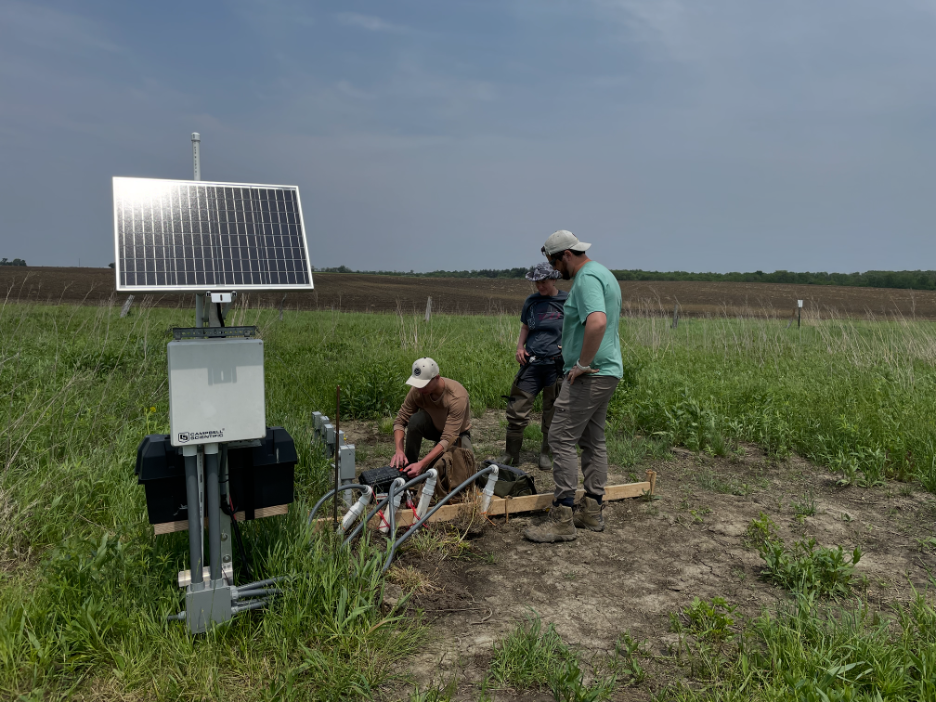
Former Purdue EAPS master’s student Ian Frantal works in the field with collaborators attending to belowground soil gas sensors, which observe soil respiration processes. (Photo provided by Lisa Welp)
A new study published in AGU Advances and highlighted by AGU Eos shows that intensively managed agricultural landscapes can move through different "regimes," or patterns of behavior, that affect how well scientists can predict critical zone function. Purdue University researchers contributed field measurements, data calibration, interpretation and manuscript development to the study, helping show how farm fields and other landscapes respond to changing environmental conditions.
The Purdue team includes Lisa R. Welp, associate professor in the Department of Earth, Atmospheric, and Planetary Sciences (EAPS), and Ian Frantal, a former EAPS master's student. Welp also is affiliated with Purdue's Institute for a Sustainable Future. Frantal contributed to field measurements, while Welp contributed to data calibration and interpretation and helped develop the manuscript.
The study, "Detecting Regimes of Critical Zone Processes, Drivers and Predictability With a Data-Driven Framework," was led by Allison Goodwell of the Prairie Research Institute at the University of Illinois Urbana-Champaign. The research team also included collaborators from the University of Nebraska Omaha and University of Illinois Urbana-Champaign departments of Earth Science and Environmental Change and Civil and Environmental Engineering.
For Welp, the work focuses on one of Earth science's most important and complicated spaces: the critical zone.
"The critical zone (CZ) refers to the layer of Earth extending from the bedrock up to the vegetation canopy, including interconnected systems such as river and floodplain corridors, the active soil and root zone, and the near-surface environment where plants interact with the atmosphere," Welp said. "The conservation of the CZ requires a detailed understanding of how it evolves under anthropogenic impacts, such as intensive agriculture."
The critical zone is where water moves through soil and rock, where plants take up nutrients, where microbes break down organic material, where carbon dioxide and water vapor move between land and atmosphere and where streams and rivers carry dissolved chemicals through a watershed. It is the part of Earth that supports agriculture, ecosystems and water quality, but it does not respond to environmental change in one simple way.
"Key features of environmental variability like stream and soil chemistry or land-atmosphere interactions of carbon dioxide and water are controlled by many different drivers like temperature, seasonal sunlight, rainfall, etc.," Welp said. "These environmental responses are non-linear functions of drivers, and furthermore, these functional relationships change over time."
In other words, the same rainstorm may not produce the same environmental response every time. Soil that is already wet can behave differently from soil that starts dry. A field in the middle of the growing season can behave differently from the same field after harvest. Fertilizer timing, drainage systems, crop growth, drought and heavy rainfall can all change which processes dominate.
To better understand those shifts, the research team developed a data-driven framework that can detect when a system changes behavior and identify the main drivers behind those changes. The framework uses mathematical tools including time-series clustering, dimensionality reduction and information theory.
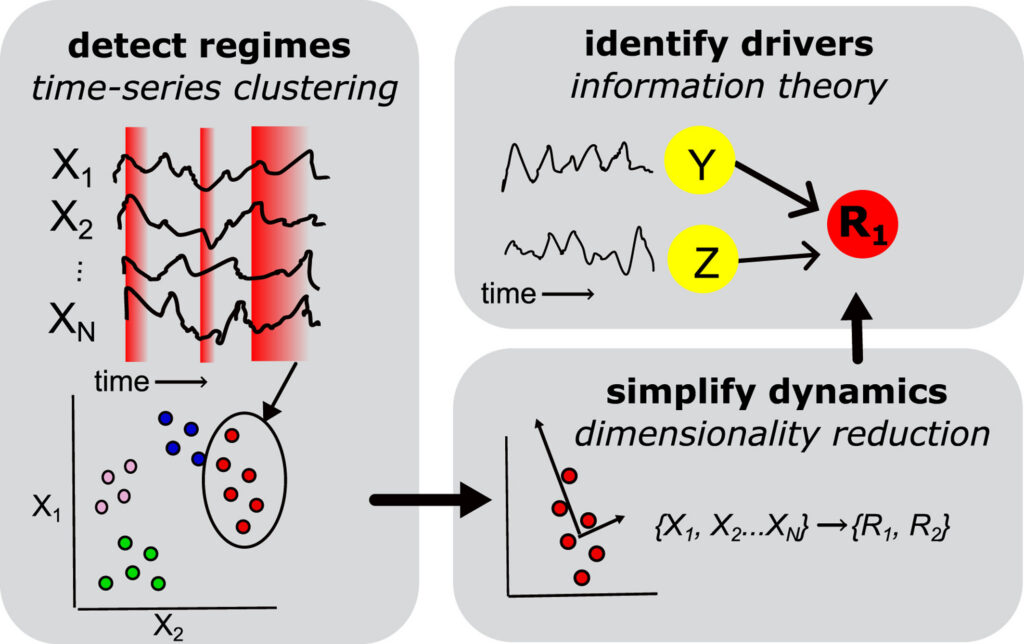
Data-driven methods include grouping of time-series data with clustering to detect regimes, dimensionality reduction to simplify system dynamics and identify main sources of variability. (Credit: Goodwell et al. [2026])
Time-series clustering helps group periods when a system behaves in similar ways. Dimensionality reduction helps simplify many moving variables into the most important patterns. Information theory helps scientists determine which environmental drivers are carrying the most useful information about a response, such as changes in stream chemistry, soil gas or land-atmosphere exchanges. Welp compares it to learning a video game without a set of instructions.
"You have to figure out how the buttons on the controller affect the characters in the game," Welp said. "And then those responses might be different with other factors in the game, like which level you are on, your health status, or the NPCs (non-playable characters) that are nearby."
In the study, those "buttons" are environmental drivers such as rainfall, temperature, soil moisture, sunlight, streamflow, fertilizer timing or crop growth stage. The "characters" are the measured parts of the critical zone, including soil gases, river chemistry and exchanges of carbon dioxide, water and energy between land and atmosphere. The "level" is the current regime, or state of the system.
By analyzing high-frequency data from intensively managed and more natural sites, the team found that critical zone systems can shift quickly and that those shifts matter for predictability. In agricultural sites, some shifts aligned with growing seasons and fertilizer applications. Other shifts reflected natural patterns such as rainfall events, drought or seasonal change.
That matters because critical zone prediction has real-world consequences. Better predictions can help scientists and land managers understand how nutrients move from fields into streams and rivers, how carbon dioxide moves between landscapes and the atmosphere, and how water and energy flow through farm fields, prairies and river corridors.
"The findings deliver innovative knowledge on transitions, drivers, and predictability in many contexts, and support better prediction and management of the critical zone under environmental change," Welp said.
The study's Purdue connection is rooted in EAPS expertise in environmental geoscience, atmospheric sciences and the movement of carbon and water between land and atmosphere. Welp's research focuses on carbon and water cycling between the terrestrial biosphere and the atmosphere, stable isotope tracers, plant water use and evapotranspiration. That expertise helped the team interpret how land-atmosphere processes fit into the broader critical zone system.
The research also highlights why field observations remain essential, even in a data-rich era. Frantal, then a Purdue graduate student, helped with field measurements, including work related to belowground soil gas sensors that observe soil respiration processes. Those measurements provide a window into what is happening beneath the surface, where microbes, roots, moisture and soil chemistry help control carbon movement.
The study was highlighted in AGU Eos under the title "Managed Agriculture Hinders Predictability of Critical Zone Features," underscoring the broader importance of the work. Agricultural landscapes are highly productive, but management choices such as drainage, crop rotations, tillage and fertilizer application can alter how the critical zone functions. Those changes can make the system more difficult to predict unless scientists can identify when and why the rules are shifting.
The framework developed in this study could be used beyond agriculture. Because it is designed to detect behavioral regimes in complex environmental data, it could help researchers evaluate other Earth system time series, improve model testing and better anticipate when a system's response to a familiar driver may no longer be familiar.
For Purdue researchers, the work is part of a larger effort to understand how human activity and environmental change reshape the systems that support food, water and climate stability.
"[The research] supports better prediction and management of the critical zone under environmental change," Welp said.
The research was supported by the National Science Foundation Critical Zone Collaborative Network project titled the Critical Interface Network, or CINet.
About the Department of Earth, Atmospheric, and Planetary Sciences at Purdue University
The Department of Earth, Atmospheric, and Planetary Sciences (EAPS) combines four of Purdue’s most interdisciplinary programs: geology and geophysics, environmental sciences, atmospheric sciences, and planetary sciences. EAPS conducts world-class research; educates undergraduate and graduate students; and provides our college, university, state and country with the information necessary to understand the world and universe around us. Our research is globally recognized; our students are highly valued by graduate schools and employers; and our alumni continue to make significant contributions in academia, industry, and federal and state government.
Written by: David Siple, communications specialist, Department of Earth, Atmospheric, and Planetary Sciences at Purdue University