When the atmosphere gets stuck, extreme weather can follow
05-18-2026
Purdue researcher helps lead international call to improve how scientists understand atmospheric blocking and its role in heat waves, droughts, floods and cold spells
Sometimes, the atmosphere gets stuck. These atmospheric traffic jams, known as blocking events, can stall weather patterns for days or weeks. When they happen, the impacts can be severe with long-lasting heat waves, droughts, wildfires, cold spells and floods. As the world warms and communities face more extreme weather, scientists are working to better understand why these blocks form, how they behave and how they may change in the future.
That challenge is at the center of a new perspective article led by Lei Wang, assistant professor of earth, atmospheric, and planetary sciences at Purdue University, and published in Nature Communications. The article, "Gaps and ways forward in atmospheric blocking and extreme weather research," outlines the biggest unanswered questions in the field and calls for new approaches to improve prediction from weather forecasts to climate projections.
"Atmospheric blocking often results in significant weather extremes and associated impacts such as heatwaves, droughts, wildfires, cold spells, and floods in mid-latitude regions," Wang said. "Blocking associated extreme weather can have devastating impacts on ecosystems and society."
The paper came out of the 2024 U.S. Climate Variability and Predictability Program, or U.S. CLIVAR, workshop "Blocking and Extreme Weather in a Changing Climate," held March 18-20, 2024, in Boulder, Colorado. Wang served as co-chair of the scientific organizing committee. About 119 researchers from around the world attended, including 83 in-person participants. Roughly 57% of participants were students and early career researchers, the highest ratio of students and early career researchers among all U.S. CLIVAR workshops in the past 20 years.
The Purdue team included Wang and Yanjun Hu, a graduate student in Wang's research group and a NASA FINESST fellow. Wang conceived the original idea for the article, wrote the first draft with input from co-authors and led revisions during peer review. Hu performed the analysis and, with input from Wang, produced most of the figures.
Atmospheric blocking is a major concern because it sits at the intersection of weather and climate. A block can shape the forecast for the next week, but understanding how blocking may change over decades requires climate science. Wang said that makes the topic an opportunity to bring together communities that do not always work in the same way.
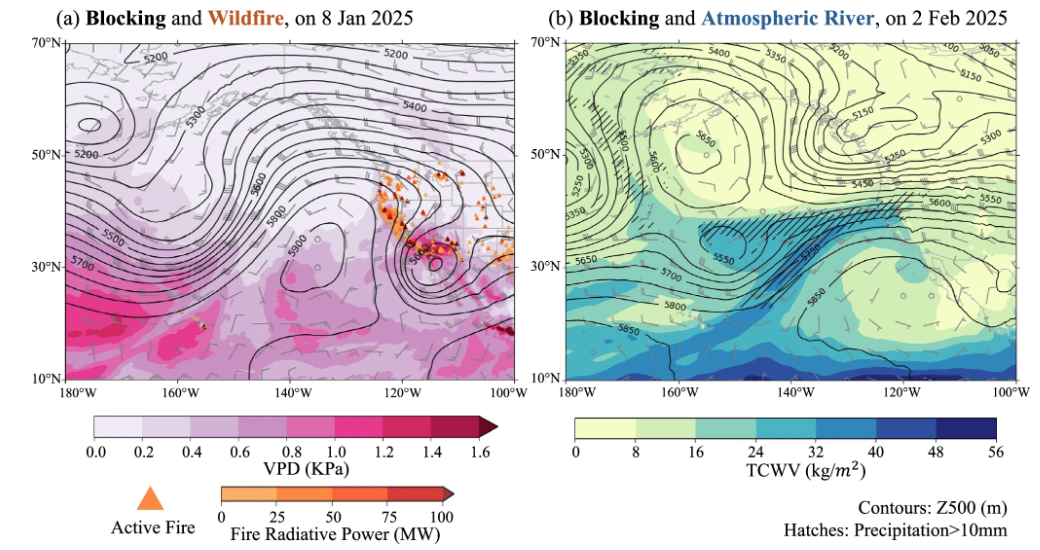
a 500-hPa geopotential height (Z500; contours) and surface vapor pressure deficit (VPD) on 8 January 2025 and active wildfire radiative power (shading) during January 2025; b Z500 (contour lines) and the total column water vapor (TCWV; shading) on 2 February 2025. Hatched areas denote regions where daily precipitation exceeds 10 mm. (Figure provided by/Lei Wang)
"Blocking is studied by both weather and climate communities, presenting a unique opportunity to amend the 'weather-climate schism,'" Wang said. "The atmospheric blocking and extreme weather research is highly interdisciplinary, requiring operational communities and stakeholders that develop and use climate information."
One reason blocking is difficult to predict is that not all blocks behave the same way. Wang compares the differences to ice cream flavors. "Just like ice creams have different flavors -- so does atmospheric blocking," Wang said. "While all blocks are 'blocked,' each type of block is blocked in its own way."
Wang and his colleagues describe that idea as "blocking diversity." The paper argues that researchers need to better account for the many forms blocking can take, including the role of diabatic heating, or heating linked to processes such as condensation and radiation, in shaping different blocking patterns.
The need is urgent. Wang noted that the past two years have brought some of the hottest summers on record for many regions of the world, including record-shattering heat waves driven by atmospheric blocking patterns. Yet the physical processes behind blocking and its associated extreme weather events are still not fully understood. Numerical models also often struggle to simulate how often blocking events happen, how long they last and where they occur.
That gap matters beyond the research community. A better understanding of blocking could improve predictions of extreme weather on subseasonal to decadal timescales, giving communities, industries, and policymakers better information for mitigation and adaptation.
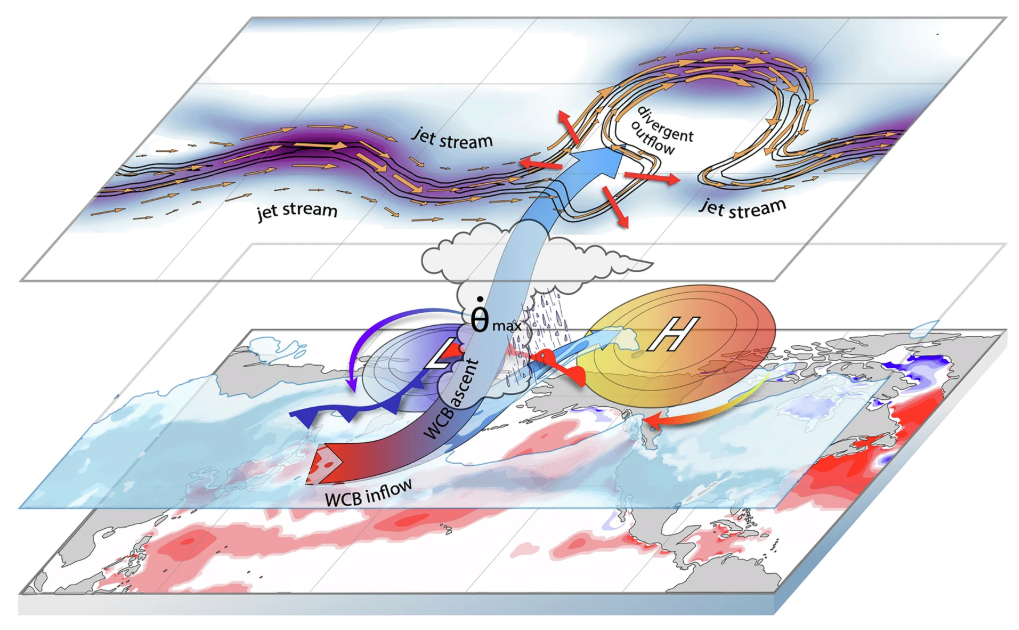
The role of an upstream cyclone, tropical moisture transport, and local warmer sea surface temperatures (SSTs) in enhancing diabatic forcing of blocking precursors; In the bottom layer, SST anomalies on 26 June, 2021, (deviation from climatology of 1979-2020, from NOAA); In the middle layer: total precipitable water; In the upper layer: zonal wind speed at 200 hPa (color shading), horizontal wind streamfunction at 200 hPa (contours), and horizontal wind direction at 200 hPa (vectors); all from ERA5. (Figure provided by/Lei Wang)
Wang's research group at Purdue studies large-scale atmospheric processes and circulation, jet streams, atmospheric blocking and extreme weather events. His work combines simple theory, hierarchical numerical modeling and analysis of observational data. More recently, he has integrated machine learning and artificial intelligence into his research. He also chaired the session "Machine Learning Applied to Geophysical Flows" at the most recent American Meteorological Society Annual Meeting.
The work is supported by collaboration across institutions and by Purdue Research Computing. Wang is also affiliated with the Purdue Institute for a Sustainable Future.
The article acknowledges U.S. CLIVAR for workshop support, with sponsorship by NOAA, NSF and the U.S. Department of Energy. Wang also acknowledges NOAA award NA24OARX431C0054-T1-01, NSF award 2411732 and Purdue seed funding through the Elevating the Visibility of Research program, provided by Purdue's Office of Research, College of Science and Department of Earth, Atmospheric, and Planetary Sciences. The Purdue seed funding supported computational resources and part of Hu's time devoted to the article.
For Wang, the goal is not only to describe what scientists do not yet know. It is to point the field toward the next step.
"We identify knowledge gaps and current challenges and provide our perspective on potential ways forward," Wang said. "The research community needs to embrace such 'blocking diversity' to better understand the diversity of blocking and extremes in a warming climate."
About the Department of Earth, Atmospheric, and Planetary Sciences at Purdue University
The Department of Earth, Atmospheric, and Planetary Sciences (EAPS) combines four of Purdue’s most interdisciplinary programs: geology and geophysics, environmental sciences, atmospheric sciences, and planetary sciences. EAPS conducts world-class research; educates undergraduate and graduate students; and provides our college, university, state and country with the information necessary to understand the world and universe around us. Our research is globally recognized; our students are highly valued by graduate schools and employers; and our alumni continue to make significant contributions in academia, industry, and federal and state government.
Written by: David Siple, communications specialist, Department of Earth, Atmospheric, and Planetary Sciences at Purdue University