Purdue researcher earns NOAA award to study the atmosphere's extreme large-scale patterns and extreme weather
05-01-2026
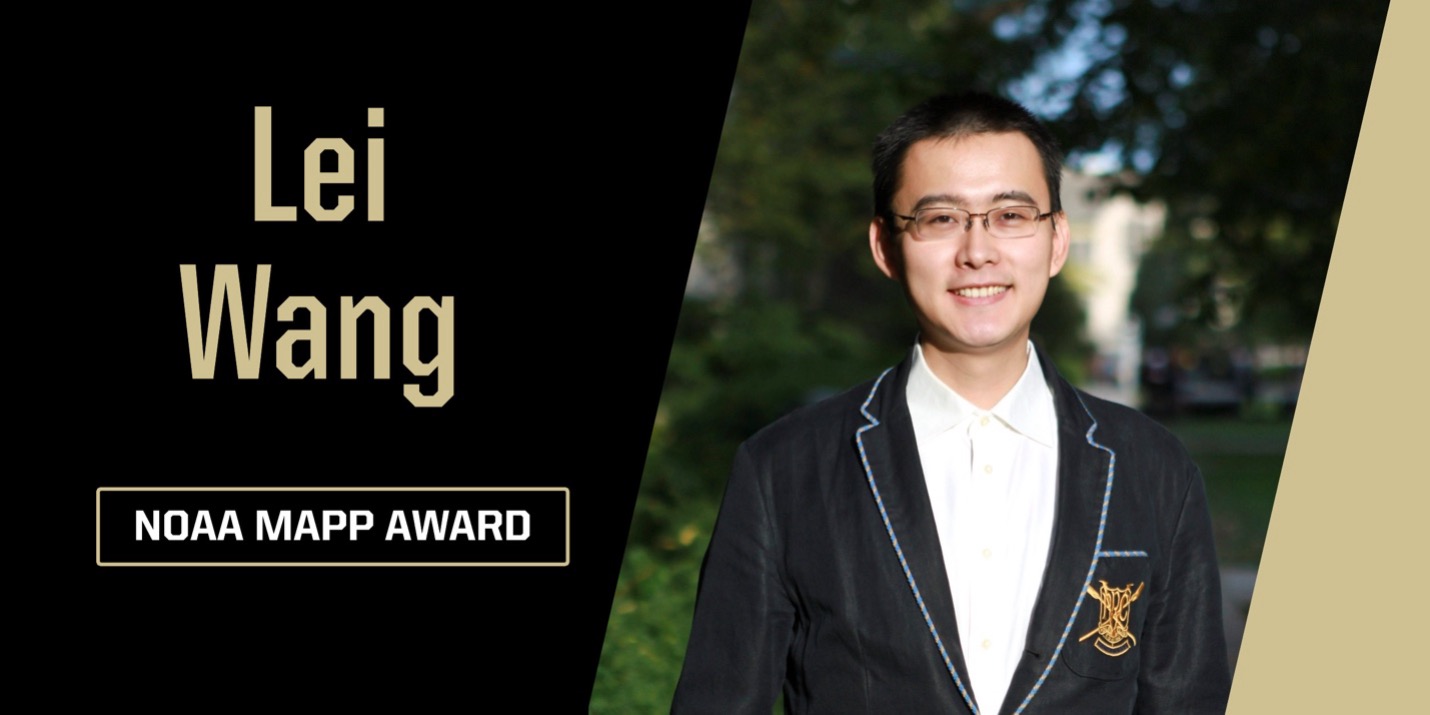
A new federal award will help Purdue University researcher Lei Wang better understand the large-scale atmospheric patterns behind extreme weather events and improve the tools scientists use to study them.
Wang, assistant professor in Purdue's Department of Earth, Atmospheric, and Planetary Sciences, has received funding through the National Oceanic and Atmospheric Administration's Climate Program Office’s Modeling, Analysis, Predictions and Projections, or MAPP, program for a project titled "Process-Oriented Diagnostics for Extratropical Rossby Wave Dynamics and Weather Extremes." The award brings $568,620 to Purdue, with a subaward of $95,956 to Boston College co-principal investigator Yi Ming. Wang leads Purdue's Weather and Climate Dynamics Laboratory, where Wang’s research focuses on large-scale atmospheric dynamics, jet stream behavior, climate and extreme weather events.
Along with Wang, the Purdue team includes Yuan-Bing Zhao, a postdoctoral researcher, and Valentina Castañeda, a PhD candidate. The award will support people and research infrastructure across the group, including a full-time postdoctoral researcher, publication costs, conference travel and data storage. It also continues a broader research push in Wang's group to understand atmospheric blocking, Rossby waves and the large-scale circulation patterns that can shape dangerous weather.
For Wang, the importance of the work starts with the stakes. "High-impact extreme events such as heatwaves, cold spells, and heavy precipitation episodes are challenging to predict on seasonal and decadal timescales and have significant societal impacts," Wang said. "In the mid-latitudes, we identify extratropical Rossby wave dynamics as a key physical process that connects large-scale atmospheric circulation and extreme weather events."
That research focus fits squarely within Wang's broader work at Purdue. Wang’s group studies large-scale atmospheric processes, jet streams, atmospheric blocking and extreme weather, with an emphasis on understanding why some weather patterns stall and grow and become more dangerous. In earlier Purdue research, Wang described Rossby waves as giant meanders in the atmosphere and helped show how those patterns can help set the stage for heat waves. In other work, his team used a traffic bottleneck theory to explain atmospheric blocking, the kind of stagnant pattern that can lock weather in place.
This new NOAA-supported project pushes that work further. "Persistent Rossby wave patterns cause high-impact extreme weather events," Wang said, "such as the July 2021 record-breaking Northwest Pacific Marine Heatwave contributing to severe drought." Wang added that these events often come with "a stagnation of large-scale atmospheric patterns commonly referred to as atmospheric blocking."
Wang put the timeline in especially clear terms. "While synoptic weather systems typically last 3-5 days, persistent Rossby wave patterns can last up to 10-20 days, causing surface extreme weather events, especially heat waves, cold spells, droughts, and heavy precipitation episodes, which have dire consequences for the public health, economy, and ecosystem on seasonal and decadal timescale," Wang said. "As a result, the dynamical processes that produce and maintain persistent Rossby wave patterns have great intellectual and societal importance."
To get at those processes, Wang's team will build a set of process-oriented diagnostics, or PODs, aimed at identifying where models succeed and where they still fall short in representing persistent Rossby wave patterns. The project will develop open-source, automated, Python-based tools that can be incorporated into NOAA's broader diagnostics framework for weather and climate models. Wang said the goal is not just to study extreme events after they happen, but to understand the model deficiencies that still prevent scientists from predicting them well on subseasonal to seasonal timescales.
Getting this award takes Wang’s research to the next level. "It allows us to connect theory, observations, and model outputs together, and echoes strongly with my group's ongoing research focus on atmospheric blocking." He said the next steps include building the PODs in collaboration with NOAA Geophysical Fluid Dynamics Laboratory scientists and Boston College.
The project is also a strong fit for Purdue. Wang is affiliated with the Purdue Institute for a Sustainable Future, and Wang said the work depends on campus research infrastructure. "We utilize high-performance computing and the Data Depot at the Purdue RCAC," he said. That combination of collaboration, computing power and atmospheric science expertise has helped make Purdue a productive place for research that sits at the intersection of weather and climate.
Wang said the group advances understanding of atmospheric blocking through "a combination of simple theory, hierarchical numerical modeling, and observational analysis," and that Wang has more recently integrated machine learning and AI into the work as well. For him, the NOAA award is both support for one project and validation of a larger research direction that keeps gaining momentum.
"NOAA is a fantastic Federal agency that allows us as PIs and scientists to conduct research at the frontiers of the weather and climate science," Wang said. At Purdue, that frontier includes some of the atmosphere's most stubborn patterns, and the extreme events they can leave behind.
About the Department of Earth, Atmospheric, and Planetary Sciences at Purdue University
The Department of Earth, Atmospheric, and Planetary Sciences (EAPS) combines four of Purdue’s most interdisciplinary programs: geology and geophysics, environmental sciences, atmospheric sciences, and planetary sciences. EAPS conducts world-class research; educates undergraduate and graduate students; and provides our college, university, state and country with the information necessary to understand the world and universe around us. Our research is globally recognized; our students are highly valued by graduate schools and employers; and our alumni continue to make significant contributions in academia, industry, and federal and state government.
Written by: David Siple, communications specialist, Department of Earth, Atmospheric, and Planetary Sciences at Purdue University