After the Impact, a Chemical Kitchen on Titan
03-16-2026
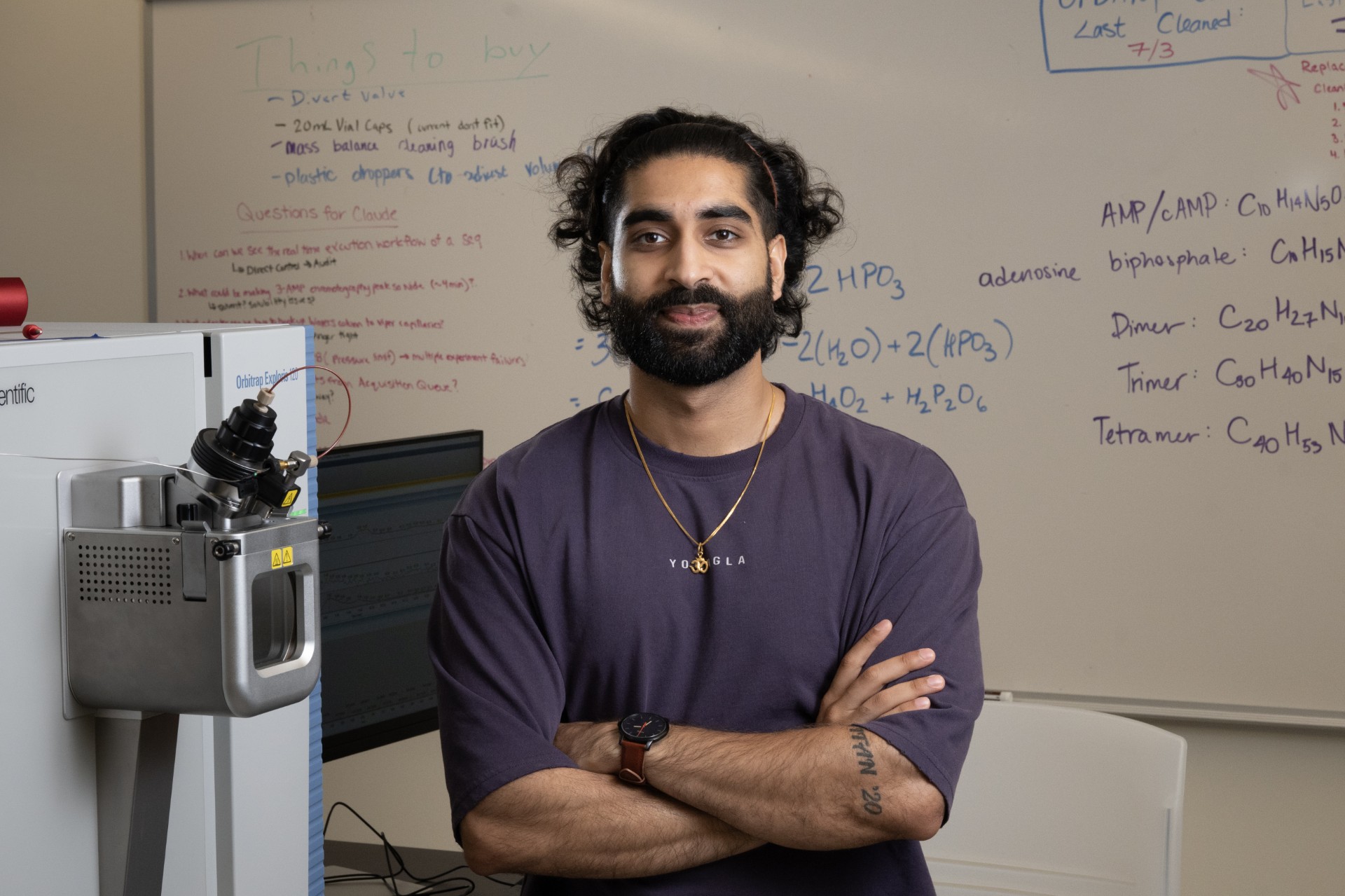
Ishaan Madan, Frederick N. Andrews Fellow and research assistant in EAPS (Purdue University photo/John Underwood)
When an asteroid slams into Saturn's moon Titan, it does more than leave behind a crater. It briefly melts Titan's frozen, water-ice crust, creating a pond of liquid water that can last for thousands of years. At the same time, Titan's thick atmosphere constantly rains down simple organic molecules onto the surface. What happens if those ingredients end up in that temporary pond?
A new study from Purdue’s Earth, Atmospheric, and Planetary Sciences (EAPS) Department suggests the answer is both surprising and hopeful. Under the right conditions, those impact-generated ponds in Selk crater could form amino acids, the molecules life uses to build proteins, through chemistry alone.
The discovery, led by Ishaan Madan, Frederick N. Andrews Fellow and research assistant in EAPS, has been published in The Planetary Science Journal. His advisor, Dr. Ben K.D. Pearce, assistant professor in EAPS, served as senior author.
Together, the two researchers asked a deceptively simple question: If Titan has the right ingredients and enough time, could it assemble some of life's fundamental building blocks without biology?
"Biology, in some way, is just fast chemistry," Madan said. "Chemistry can build complex molecules on its own, but at a slower pace. Titan's environment provides the simple organics from its atmosphere to the ponds that have tens of thousands of years to react. Essentially, Titan gives ordinary chemistry the time it needs to assemble some of the same molecules that life uses on Earth."
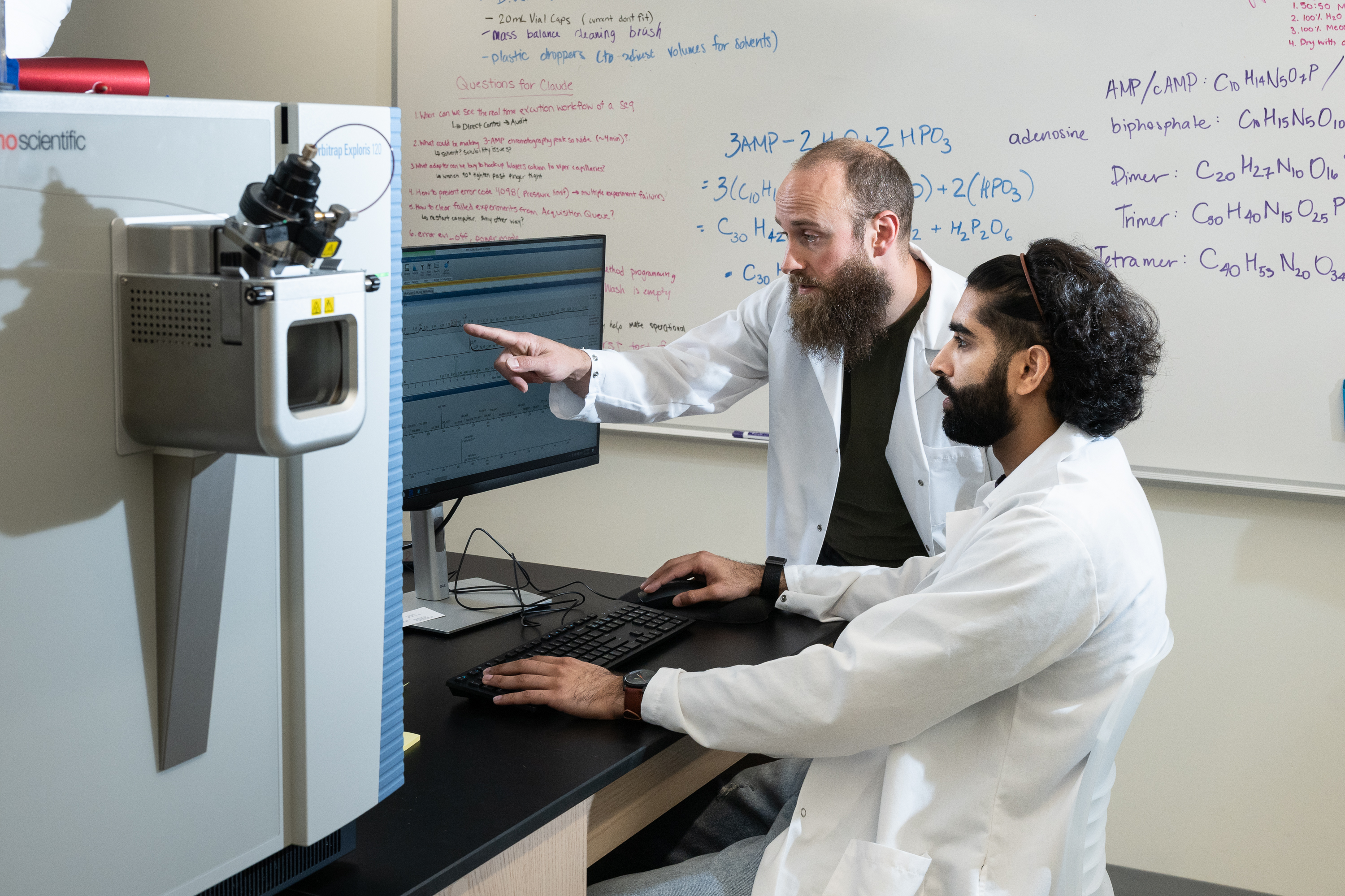
Ben Pearce, left, and Ishaan Madan review research data in the lab at Purdue University. (Purdue University photo/John Underwood)
Titan is coated in organic compounds formed high in its atmosphere. When sunlight and energetic particles break apart methane and nitrogen, they recombine into molecules like hydrogen cyanide and acetylene. Over time, those molecules settle onto the icy surface.
Madan built detailed thermodynamic models to simulate what would happen if those molecules mixed with liquid water inside Selk crater after an impact. Using high-performance computing through Purdue's Rosen Center for Advanced Computing, he evaluated whether 21 amino acids could form under Titan-like conditions.
According to the abstract of the published study, the team assessed "whether mixtures of hydrogen cyanide (HCN), acetylene (C2H2), and ammonia (NH3) can drive amino acid synthesis in Selk-sized craters."
With even small amounts of ammonia, nearly the full suite of canonical amino acids becomes thermodynamically accessible. Without ammonia, only a handful form. But one result stood out: alanine, a common amino acid, could form even without ammonia under Titan conditions. That suggests Titan's chemistry may follow pathways rarely considered on early Earth.
"The models Ishaan developed also potentially revealed some exciting new amino acid chemistry that may be uniquely occurring on Titan,” says Pearce. “Alanine is produced in our thermochemical models without ammonia, from C2H2, HCN, and H2O. This is not a likely mixture that you would find on Earth, but would be quite common for post-impact ponds on Titan. Our future goals include validating these exciting theoretical results by trying to reproduce this novel alanine chemistry in our laboratory.”
The work is more than a theoretical exercise. It directly informs NASA's upcoming Dragonfly mission, a rotorcraft lander set to arrive on Titan in the mid-2030s.
Dragonfly will explore Selk crater and carry a mass spectrometer designed to detect organic molecules on the surface. Madan's models help predict which amino acids are most likely to be present and under what chemical conditions.
"These models are critical groundwork for the Dragonfly mission,” says Pearce. “Now, we have a reasonable idea of what amino acids Dragonfly is most likely to find when it starts sampling Selk crater. This also gives the Dragonfly team a predicted molecular profile to inform instrument protocol development for the on-board GC-MS."
The study even recommends specific amino acids for preflight testing, including alanine, beta-alanine and proline, which appear robust across a range of chemical scenarios.
Importantly, the presence of amino acids on Titan would not mean life exists there. "Our results show that these molecules can form without biology, through chemistry alone," Madan said. "So, if we detect them on Titan, it would be evidence of interesting pre-life chemistry and not living organisms."
Madan said he chose Purdue specifically to work with Pearce. "The main reason I chose Purdue was because of my advisor, Ben Pearce," he said. "His background and interests aligned extremely well with what I hoped to explore."
He also pointed to the department's growing reputation in planetary science and space exploration, along with access to advanced computing resources that were essential for running the simulations. The research relied on the Negishi cluster at the Rosen Center for Advanced Computing.
Madan was supported by the Frederick N. Andrews Fellowship and recently received a National Science Foundation Graduate Research Fellowship, which he will begin using in fall 2026.
Beyond Titan, the study challenges assumptions about how life's building blocks form. For decades, much of prebiotic chemistry has centered on Earth-like conditions. Titan offers a radically different environment, rich in hydrocarbons and frozen landscapes punctuated by impact-driven melt ponds.
If amino acids can emerge from feedstocks like acetylene on Titan, it suggests that the chemistry leading toward life may not be limited to Earth's particular recipe.
"Dragonfly will explore Titan's surface and test whether these building blocks are actually present," he said. "It will give us our first real chance to see how far chemistry can go on a world that is very different from Earth." If Titan's chemical kitchen is still leaving traces in Selk crater, Purdue scientists have helped draw the menu.
About the Department of Earth, Atmospheric, and Planetary Sciences at Purdue University
The Department of Earth, Atmospheric, and Planetary Sciences (EAPS) combines four of Purdue’s most interdisciplinary programs: geology and geophysics, environmental sciences, atmospheric sciences, and planetary sciences. EAPS conducts world-class research; educates undergraduate and graduate students; and provides our college, university, state and country with the information necessary to understand the world and universe around us. Our research is globally recognized; our students are highly valued by graduate schools and employers; and our alumni continue to make significant contributions in academia, industry, and federal and state government.
Written by: David Siple, communications specialist, Department of Earth, Atmospheric, and Planetary Sciences at Purdue University
Contributors: Ishaan Madan, Frederick N. Andrews Fellow and Research Assistant in the Earth, Atmospheric, and Planetary Sciences Department at Purdue University. Lead author.
Ben Pearce, assistant professor in the Earth, Atmospheric, and Planetary Sciences Department at Purdue University. Senior author and advisor.