Purdue EAPS welcomes visiting assistant professor Kwesi Twentwewa Quagraine
11-04-2026
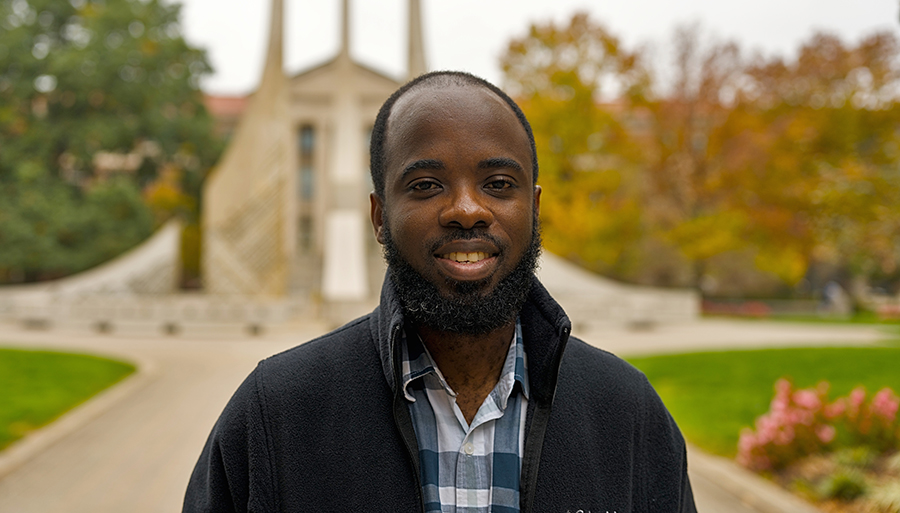
The Department of Earth, Atmospheric, and Planetary Sciences (EAPS) welcomes Kwesi Twentwewa Quagraine as a visiting assistant professor. He started with EAPS in the 2026 fall semester.
His research centers around weather systems behind extreme rainfall, flooding, and heat, and how those systems might change as the climate changes. These include hurricanes, large, organized thunderstorms, and atmospheric rivers — long corridors in the atmosphere that transport enormous amounts of water vapor.
“I use observations, reanalysis, and numerical and AI weather and climate models to understand what makes an event particularly damaging and how well we can predict it,” he says. “One approach is to ‘replay’ a historical storm in a different climate and ask how its rainfall, winds, and effects on communities might change. I also investigate whether artificial intelligence can improve extreme-weather prediction and how proposed climate interventions could affect regional weather hazards.”
Before joining Purdue, he was a postdoctoral researcher in the Department of Atmospheric Sciences at Texas A&M University, working on tropical cyclones, high-resolution weather modeling, and extreme-weather prediction.
“I have also collaborated with scientists at the National Center for Atmospheric Research, and the Lawrence Berkeley National Laboratory” said Quagraine.
Quagraine teaches Great Issues in Climate Science (EAPS 360), Synoptic Meteorology Laboratory (EAPS 431), Synoptic/Weather Analysis (EAPS 433), and Advanced Earth Science Data Analysis (EAPS 507). These courses span the science and societal dimensions of climate change, interpreting weather systems, and using programming and data analysis to investigate Earth science questions. Across his teaching, he enjoys helping students connect classroom concepts with real weather events and research.
“Purdue offered an opportunity to bring together two parts of academic life that matter deeply to me: teaching and research,” he said. “EAPS is a place where questions about weather and climate connect with a much broader understanding of the Earth system. I was excited by the opportunity to contribute my expertise in climate and weather extremes using state-of-the-art climate and weather prediction while learning from colleagues with different perspectives. I also wanted to help students develop the confidence to ask their own scientific questions and investigate them.”
He is from Cape Coast, Ghana, where he says the weather is certainly different. “In Ghana, the seasonal rhythm is shaped more by wet and dry periods than by the four seasons we experience here. Moving to Indiana meant adjusting to much colder winters. West Lafayette is also something of a return to familiar territory: I spent several years in Bloomington during graduate school, so Indiana already feels like an important part of my story.” When not working, he enjoys playing musical instruments and pickle ball.
Quagraine earned his bachelor’s degree in Meteorology and Climate Science at Kwame Nkrumah University of Science and Technology in Ghana. He then completed his master’s degree and Ph.D. in Earth and Atmospheric Science at Indiana University Bloomington. His graduate research examined atmospheric rivers and interactions between weather systems that produce extreme precipitation.
“Mentoring and making science accessible are important to me,” he says. “I enjoy helping students move from learning a method to using it to answer a question they care about. I am also always happy to talk about weather, climate, or an interesting dataset or tool, and I look forward to finding connections across EAPS.”
About the Department of Earth, Atmospheric, and Planetary Sciences at Purdue University
The Department of Earth, Atmospheric, and Planetary Sciences (EAPS) combines four of Purdue’s most interdisciplinary programs: Geology & Geophysics, Environmental Sciences, Atmospheric Sciences, and Planetary Sciences. EAPS conducts world-class research, educates undergraduate and graduate students, and provides our college, university, state and country with the information necessary to understand the world and universe around us. Our research is globally recognized, our students are highly valued by graduate schools, employers, and our alumni continue to make significant contributions in academia, industry, and federal and state government.
Written by: Cheryl Pierce, Purdue University College of Science
Contributors: Kwesi Twentwewa Quagraine, visiting assistant professor in the Department of Earth, Atmospheric, and Planetary Sciences
Photo by: Aaron Basiletti, Purdue University College of Science