Eddy earns NSF CAREER Award
10-10-2025
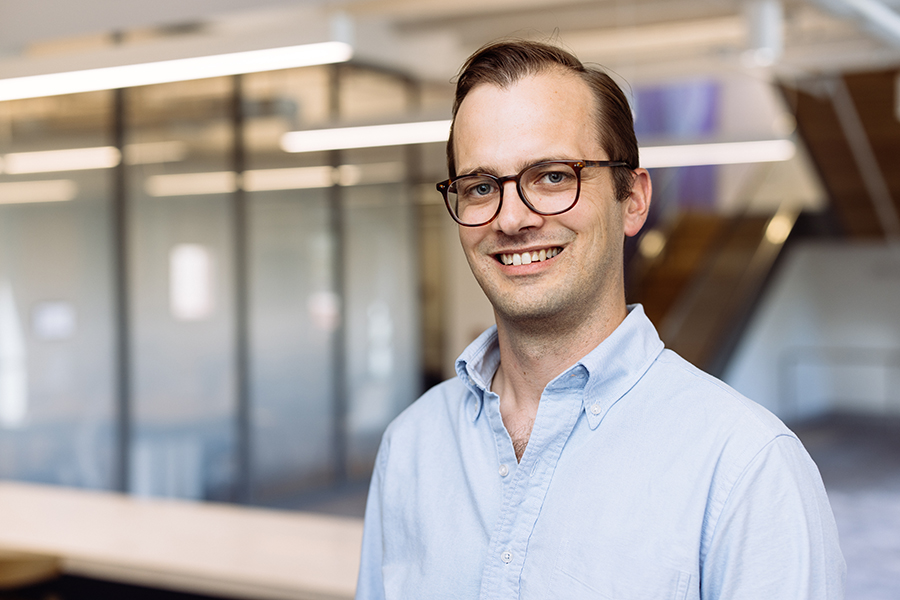
Michael P. Eddy, associate professor in Purdue University's Department of Earth, Atmospheric, and Planetary Sciences, has received a National Science Foundation (NSF) Faculty Early Career Development (CAREER) Award to study the movement of magma within an ancient volcanic system and its relationship to past eruptions.
The project will examine an ancient volcanic system whose deeper rocks have been exposed at Earth’s surface by erosion. This gives Eddy and his research group access to parts of the system that are normally hidden beneath active volcanoes.
"We will use precise age determinations to reconstruct the history of an ancient volcanic system," Eddy said. "Studying an ancient system is advantageous because erosion has brought rocks that were deep below the ancient volcano to the Earth's surface today. Through reconstructing magma movement and eruption in this ancient system we should help improve our ability to interpret data from modern volcanoes as they are evaluated for hazard."
Much of the research will take place in Purdue EAPS' Radiogenic Isotope Geology Lab, which houses a thermal ionization mass spectrometer, or TIMS. Eddy's group uses radioactive decay of uranium to lead to precisely determine the ages of Earth materials. Those measurements allow researchers to reconstruct when events happened and compare the movement of magma underground with the timing of eruptions.
For Eddy, putting those pieces together is one of the most exciting parts of the project. "I'm most excited to reconstruct a volcanic history," Eddy said. "I love to go into a new area and piece together a series of past events. It's detective work, just on a natural system in deep time."
The CAREER award will also support at least one new graduate student. The project builds on Eddy's broader research at Purdue, where his group uses precise rock dating to study volcanic histories, the evolution of sedimentary basins, interactions between tectonic plates, past climate change and the timing and rates of extinctions.
Eddy said improvements in scientists' ability to precisely determine the ages of rocks are allowing geologists to investigate connections between Earth processes over increasingly short periods of geologic time.
"Geology experienced a scientific revolution in the 1960s as plate tectonics was described," Eddy said. "More recently, I think the most exciting research has been focused on understanding the inter-relationships between different Earth processes over short timescales. My group gets to play a role in this because we are able to determine the age of rocks very precisely. It allows us to interrogate Earth processes on a fine scale."
Eddy joined Purdue in fall 2019 and is an associate professor in EAPS. His research focuses on igneous petrology and tectonics, combining field observations with high-precision geochronology to reconstruct events in Earth's past.
The NSF CAREER Award is the National Science Foundation's premier award for early-career faculty. It recognizes researchers with the potential to serve as academic leaders while integrating research and education throughout their careers.
About the Department of Earth, Atmospheric, and Planetary Sciences at Purdue University
The Department of Earth, Atmospheric, and Planetary Sciences (EAPS) combines four of Purdue’s most interdisciplinary programs: geology and geophysics, environmental sciences, atmospheric sciences, and planetary sciences. EAPS conducts world-class research; educates undergraduate and graduate students; and provides our college, university, state and country with the information necessary to understand the world and universe around us. Our research is globally recognized; our students are highly valued by graduate schools and employers; and our alumni continue to make significant contributions in academia, industry, and federal and state government.
Written by: David Siple, communications specialist, Department of Earth, Atmospheric, and Planetary Sciences at Purdue University
Contributors: Michael Eddy, associate professor in Purdue University’s Department of Earth, Atmospheric, and Planetary Sciences
Photo by: Brian Powell